
Can Plants Using Wood, Plastic, or Composite Boards Also Benefit from Steel Boards?
 Resources Articles & News Can Plants Using Wood, Plastic, or Composite Boards Also Benefit from Steel Boards?
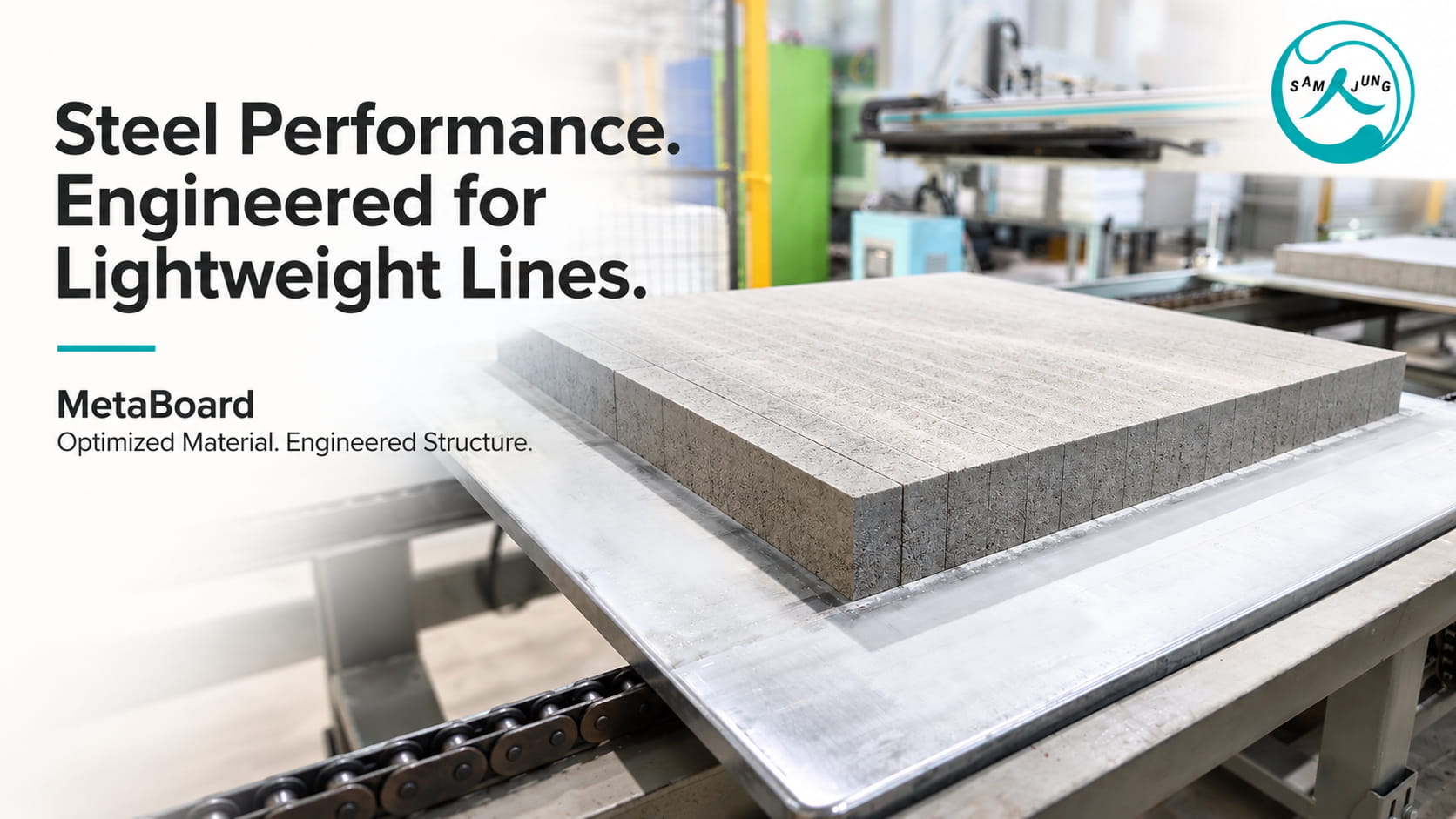
Rethinking Weight
What if you need the performance of steel but cannot use it because of its weight?
Many concrete block and paver plants around the world use relatively lightweight production boards made from wood, plastic, GMT, composite materials, and other lightweight materials.
This is not necessarily because they do not need the performance of steel. If an existing production line is designed around lightweight production boards, replacing them with much heavier conventional steel boards involves practical limitations.
A production board is not a component used only inside the molding machine. It moves through elevators, finger cars, conveyors, and other equipment before circulating back through the production line.
Therefore, a substantial increase in board weight can affect the entire handling system that moves it.
Then, must a plant that wants to benefit from the characteristics of steel also replace its production equipment?
Or must it continue using its existing boards?
Samjung began with a different question.
Could we create a lightweight steel production board that retains the advantages of steel while fitting into existing production lines using wood, plastic, GMT, or composite production boards without major structural changes?
Must Weight and Performance Always Increase Together?
The behavior of a vibrating structure is not determined by its material alone.
The most basic structural dynamics model can be expressed as follows:
mẍ + cẋ + kx = F(t)
• m = Mass
• c = Damping
• k = Stiffness
• F(t) = Externally applied dynamic force
In other words, the behavior of a production board under repeated vibration can also be understood as the combined effect of mass, stiffness, damping, and structure, rather than weight alone. In structural dynamics, the response of a vibrating system is explained through the relationship between mass, stiffness, and damping, while vibration transmissibility is also influenced by these variables and the excitation frequency.
This raises an important question.
What if we could reduce the weight of a steel board while maintaining the required stiffness?
Simply Making It Thinner Is Not Lightweight Engineering
The easiest way to reduce weight is to reduce the thickness of the steel.
But for a production board, reducing weight alone is not enough.
The board must support products stably under repeated loads and vibration while limiting excessive deflection and deformation.
A structure’s natural frequency is also fundamentally determined by the relationship between mass (m) and stiffness (k), as follows:
fₙ = (1/2π)√(k/m)
In other words, reducing weight by changing only mass, without considering stiffness and structural characteristics, can alter the structure’s dynamic behavior itself.
Experimental studies of actual concrete block production have also examined the relationship between the stiffness and damping characteristics of production pallets and the quality of concrete products, showing that a pallet’s dynamic characteristics are one variable in the molding conditions.
Therefore, the central principle of a lightweight production board is not simply weight reduction.
It is structural optimization.
Designing the Structure Instead of Simply Reducing Material
Conventional steel boards (steel pallets) achieve structural performance by using steel throughout the required thickness.
However, the required performance does not necessarily have to be achieved in the same way.
Samjung redesigned the internal structure of the production board itself.
The result is MetaBoard.
MetaBoard is not simply a thinner version of a conventional steel board (steel pallet). It is a lightweight steel production board developed with the aim of reducing steel use and overall weight through internal structural design, while securing the support capacity and vibration transmission characteristics required of a production board.
The central principle is not simply less steel.
Optimized Material. Engineered Structure.
MetaBoard starts from the idea that, by placing material where it is needed and supporting loads through its engineered structure, board performance and board weight do not necessarily have to remain in the same proportion.”
New Options Created by Lightweight Steel Boards
The true significance of lightweight engineering is not simply making production boards easier to transport.
It is about creating a new option for production lines that have previously found it difficult to adopt conventional steel boards (Steel pallets) because of their weight.
MetaBoard and AlphaBoard aim to deliver the high support capacity and vibration transmission characteristics associated with steel production boards, while offering weight and dimensional ranges suitable for production lines currently using wood, plastic, GMT, or composite production boards.
In particular, MetaBoard aims to provide a lightweight steel solution that can be integrated into automated dry-cast vibrocompaction production lines using wood, plastic, GMT, or composite production boards without major changes to the existing handling system or machine configuration.
Ultimately, the question no longer needs to be:
“Should we choose a conventional steel board (Steel pallet) or a lightweight steel board?”
The more important question is:
“Can we achieve the performance expected from conventional steel while significantly reducing board weight?”
This is the longstanding relationship between weight and performance that Samjung has reconsidered through MetaBoard.
Rather than assuming that heavier always means better, Samjung focuses on optimizing materials and structural design to achieve the required performance and service life at a significantly lower weight.
That is the new direction presented by lightweight steel production boards.