
From Production Board to Smart Asset
 Resources Articles & News From Production Board to Smart Asset
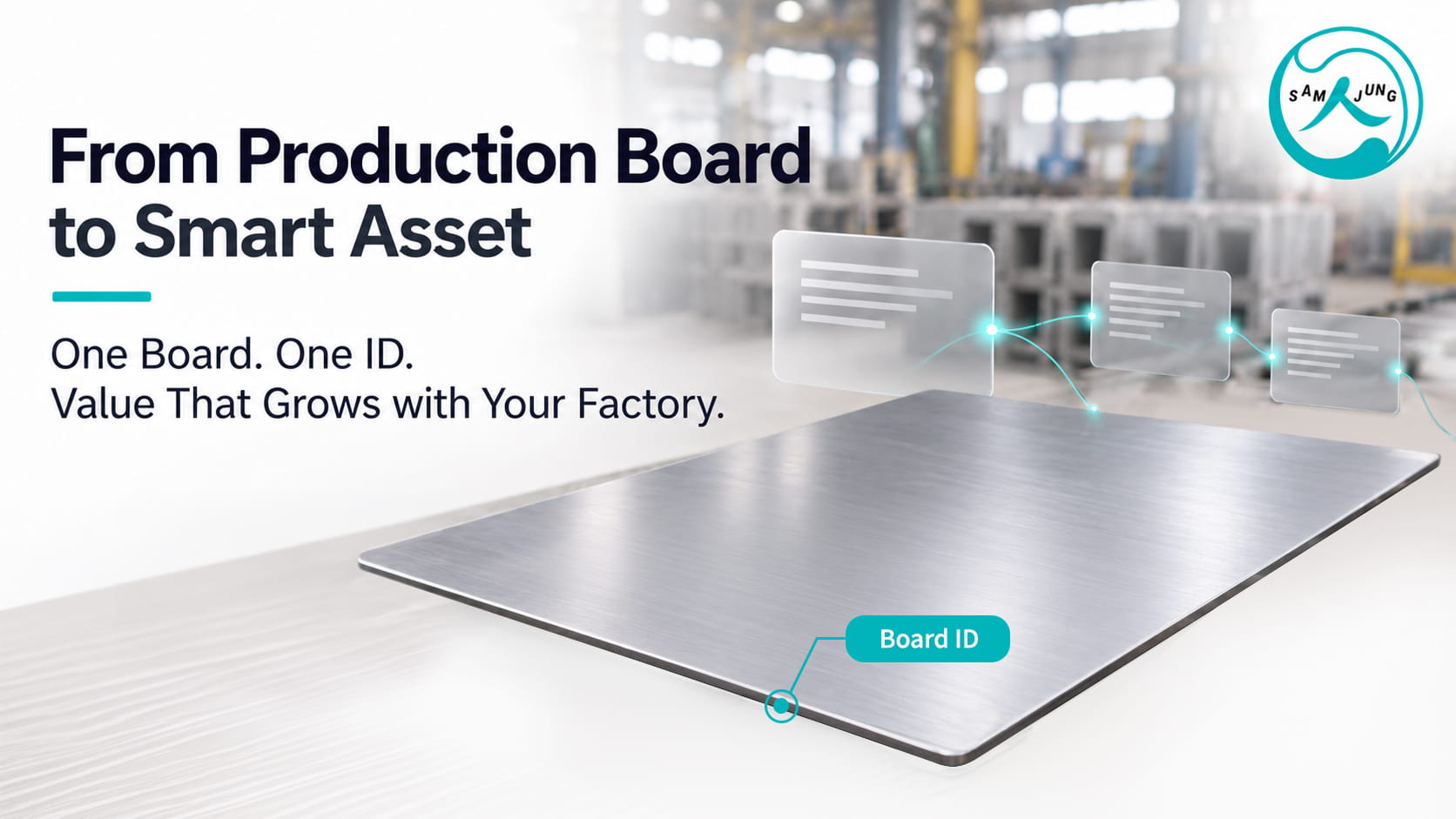
Can a Production Board Become a Data Reference Point for a Smart Factory?
Smart factories do not look the same in every plant.
Some plants begin with basic production history management, some have MES connected to their production equipment, and plants with higher levels of automation integrate and analyze data from multiple processes.
Therefore, assigning an ID to a production board does not, in itself, turn a plant into a smart factory.
What Samjung aims to provide is not a complete smart factory system itself, but a digital identity and data reference point for production boards whose use can expand in line with the customer’s plant environment and level of digitalization.
Why a Production Board ID?
Production boards have a characteristic that sets them apart from other production equipment.
While the block machine, curing room, cuber, and inspection system perform their roles at their respective locations, production boards continuously circulate throughout the production line, following the cycle of molding → demolding → transfer → curing → stacking and packaging → cleaning → reintroduction.
Because of this characteristic, giving each board a unique ID offers greater possibilities than simply being able to distinguish one board from another.
It gives a digital identity to a physical asset that moves throughout the plant.
Samjung assigns a unique ID to each production board.
How that ID is subsequently used, and how far its use extends, can vary depending on the customer’s production environment and level of smart factory development.
One ID, Different Uses
Not every customer needs to build a complex system from the outset.
At a basic level, customers can begin by using IDs to identify individual production boards and manage their usage histories.
As the plant’s level of digitalization increases, the range of applications can also expand.
Board Identification
↓
Cycle / Cleaning / Maintenance History
↓
Flatness & Board Condition Data
↓
Production Traceability
↓
Machine / Molding / Curing / Inspection Data Connection
↓
MES / Data Analytics / Predictive Quality
For example, depending on the customer’s system environment, usage counts, cleaning and maintenance histories, flatness measurements, and other information can be linked to a board ID.
In plants where production equipment and data systems are interconnected, the board ID can also serve as a traceability key linking data from different processes, such as molding conditions, curing conditions, and inspection results.
In other words, not every plant has to use an ID in the same way.”
An ID Whose Uses Expand as the Smart Factory Develops
This is the greatest potential of assigning an ID to a production board.
Today, it can simply be used to record how many times a board has been used.
If the customer later introduces MES or increases data connectivity between equipment, the same ID can also be used to manage production history.
In plants with more advanced data analytics environments, its use can also expand to tracing quality problems back to their origins or analyzing the relationship between board condition and production conditions using data accumulated over time.
Therefore, the value of an ID-equipped production board, as defined by Samjung, is not tied to a particular smart factory system.
Its value lies in the possibility that the uses of the ID can expand as the customer’s smart factory develops.
A Small ID Creates Big Possibilities
Production boards repeatedly move throughout the plant over countless production cycles.
For this reason, a unique ID on a board can have considerable significance when looking to the future.
Importantly, this does not mean that Samjung directly transforms the customer’s plant into a smart factory.
Samjung provides production boards with a digital identity.
Customers can use it in stages according to their plant environment and level of automation. As production history accumulates around the same board ID, the production board can evolve from a simple machine component into a smart asset that connects production quality data.
It can begin with simple board identification,
or be used for maintenance management.
In plants that require process tracking, it can develop into a traceability key;
in plants with MES, it can develop into a reference point connecting different production data.
One Board. One ID. One Traceable Production History.
The ID is provided. Its value grows with the factory.
Assigning a single ID to a production board that circulates throughout the plant.
It may seem like a small change, but as customers develop their smart factories, the range of uses for that ID can grow considerably.
From Production Board to Smart Asset.