
Not all Steel Production Boards (Steel Pallet) are the same
 Resources Articles & News Not all Steel Production Boards (Steel Pallet) are the same
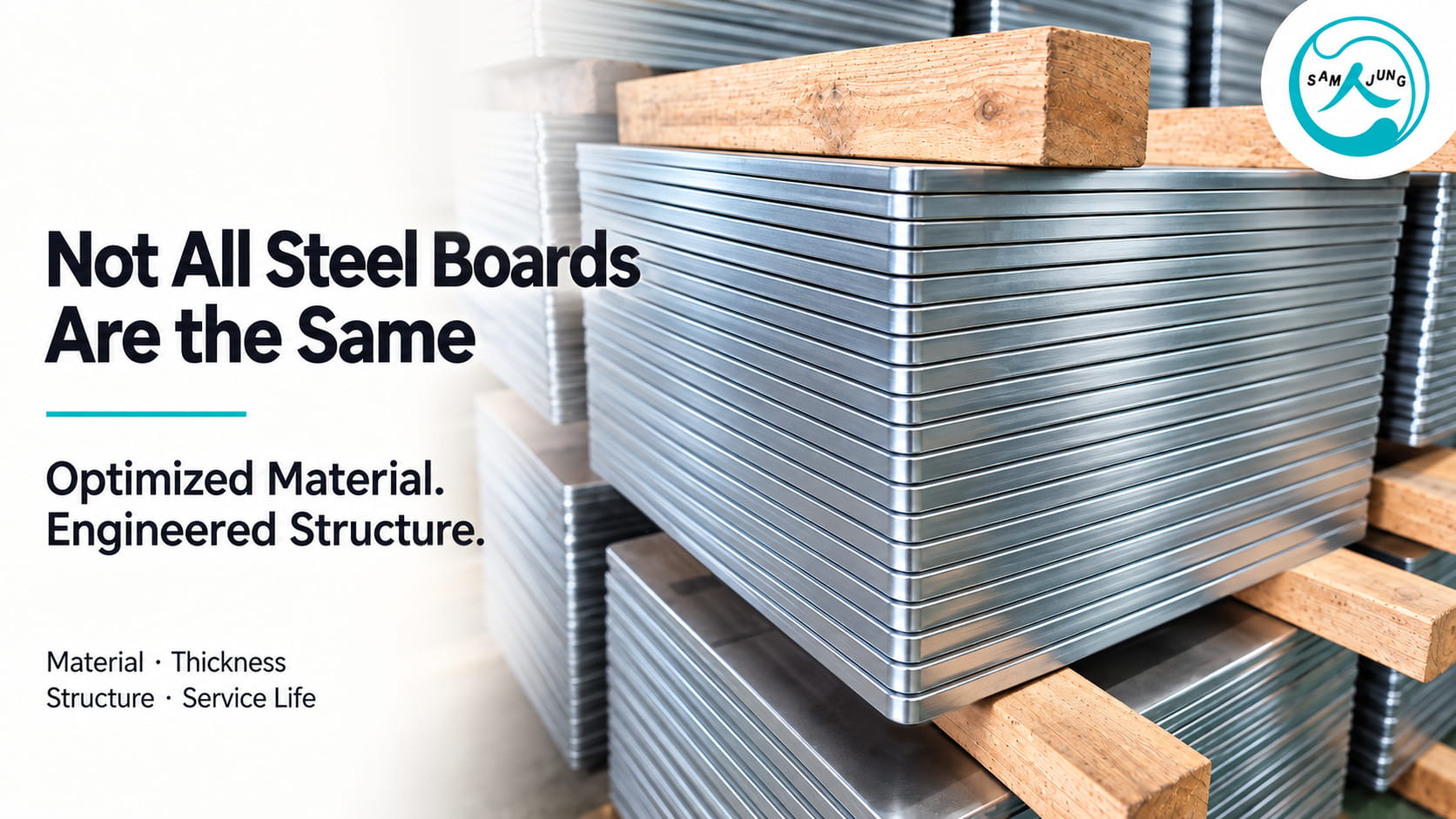
Are All Steel Boards the Same?
Steel production boards (steel pallets) may look similar from the outside.
However, even steel boards (steel pallets) of the same size can differ in the amount of steel required, board performance, and service life, depending on the material used and the thickness and structure of the design.
Therefore, simply looking at size and weight is not enough when comparing steel production boards (steel pallets).
The important question is:
“How efficiently is steel being used to achieve the required performance?”
Does a Thicker Steel Production Board (Steel Pallet) Mean a Better Production Board?
A steel production board (steel pallet) must provide stable support for concrete products, including blocks and pavers, under repeated vibration and loads. Therefore, sufficient stiffness and structural stability are essential.
The simplest approach to increasing these properties is to increase the thickness and amount of steel. However, using more steel than necessary increases not only the weight of the steel production board (steel pallet) but also the amount of material required to manufacture it.
Conversely, simply making the board thinner to reduce steel use may make it difficult to achieve the required stiffness and dimensional stability.
Ultimately, the goal of engineering is neither to create the thickest board nor the lightest board.
It is to use material as efficiently as possible while achieving the required performance and service life.
From Thickness to Structure
This is where structural design becomes important.
A structure’s resistance to bending is not determined solely by the amount of material. The material used and how it is distributed within the cross-section also affect structural performance.
In other words, using steel efficiently requires redesigning the structure itself rather than simply reducing thickness.
This is the starting point for MetaBoard.
MetaBoard is a lightweight steel production board designed to optimize steel use and overall weight while achieving the required structural performance through an engineered internal structure, rather than simply reducing the weight of an existing steel production board.
Put simply:
Material Selection
×
Optimized Thickness
×
Engineered Structure
×
Service Life
↓
Required Performance with Optimized Material
Why Material Efficiency Can Lead to Carbon Reduction
When considering the environmental impact of a steel production board, it is necessary to consider not only the energy consumed during use but also the material used to manufacture the board itself.
Steel can carry greenhouse gas emissions generated before the product is manufactured, from raw material production through steelmaking, rolling, and processing. This environmental burden embodied in the product can be assessed from the perspective of embodied carbon.
Therefore, if the amount of steel used in a production board can be optimized while maintaining the required performance and service life, this can contribute to reducing embodied carbon per board.
This is why Samjung does not view MetaBoard’s lightweight design simply as a product characteristic of being “light.”
But Sustainability Cannot Be Judged by Weight Alone
There is another important condition here.
Service Life.
Even if the amount of steel used in a single board is reduced, if its service life becomes shorter and it needs to be replaced more frequently, material efficiency is difficult to assess based solely on the weight of one board.
Therefore, sustainable production board design must consider both
how little material is used and
how long its performance is maintained.
What Samjung pursues is not simply minimum weight, but Optimized Material for Required Performance, Reliability and Service Life.
In other words, it means using material efficiently while achieving the required performance and service life.
Material × Thickness × Structure × Service Life
Ultimately, the reason not all steel boards are the same is simple.
Material determines what performance can be achieved, thickness balances the required stiffness with material use, structure determines how efficiently that material can be used, and service life determines the long-term value of the design.
MetaBoard treats these elements as a single engineering problem.
Instead of using more steel, it means designing the structure to use the required amount of steel where it is needed.
Through this approach, MetaBoard aims to reduce unnecessary material use while achieving the performance and service life required of a steel production board.”
Not All Steel Boards Are the Same
Carbon reduction does not simply mean using new environmentally friendly materials.
Using existing materials more efficiently and for longer is also an important approach.
Therefore, when comparing steel production boards, rather than simply asking:
“How thick is it?” “How heavy is it?”
It is also necessary to ask:
“How efficiently is steel being used to achieve the required performance and service life?”
Optimized Material. Engineered Structure. Longer Service Life. Lower Embodied Carbon.
Not All Steel Boards Are the Same.