
Beyond Conventional Steel: Engineering POSSJ & HS540 for Concrete Production
 Resources White Papers Beyond Conventional Steel: Engineering POSSJ & HS540 for Concrete Production
Beyond General-Purpose Structural Steel: Specialized Material Design Reflecting the Requirements of Actual Production Environments
Material Technology White Paper | Samjung Industries Co., Ltd.
Executive Summary
Steel Production Boards (Steel Pallets) used in concrete block and paver production have long been manufactured from general-purpose structural steel. General-purpose steel offers competitive pricing and a stable supply and has been widely used across various industries. These advantages have supported the continued use of Steel Production Boards (Steel Pallets) in production environments.
When selecting materials for Steel Production Boards (Steel Pallets), actual operating conditions must be considered alongside these advantages. Steel Production Boards (Steel Pallets) move along the production line while supporting the weight of concrete products and are subjected to repeated vibration and loading during forming. They may also be exposed to mechanical contact with equipment, concrete residue, moisture, cleaning, and impact. In environments where these conditions act together, tensile strength alone is insufficient to assess the suitability and long-term performance of Steel Production Boards (Steel Pallets).
Tensile strength (TS) and yield strength (YS) are key indicators for evaluating a material’s mechanical performance. However, when assessing steel for Steel Production Boards (Steel Pallets), corrosion resistance, wear resistance, chemical composition, and manufacturing process compatibility must also be examined alongside these two indicators. This is because it is important to understand how each property functions under actual production conditions and whether the required performance can be achieved in finished Steel Production Boards (Steel Pallets). Drawing on the understanding of production environments gained through its extensive experience in manufacturing Steel Production Boards (Steel Pallets), Samjung has systematically examined the balance among these properties as the starting point for material development.
Samjung seeks to develop steel for Steel Production Boards (Steel Pallets) that delivers a balanced combination of the performance characteristics required in actual production environments.
Rather than simply selecting materials, Samjung collaborated with POSCO to develop POSSJ, a specialized steel grade for Steel Production Boards (Steel Pallets), to incorporate these production requirements into steel design. POSSJ’s development focuses on achieving the required mechanical performance while adjusting chemical composition to address both corrosion resistance and wear resistance, with the aim of improving long-term service life. Accordingly, POSSJ’s value as a material can be understood through the combined effects of tensile strength, yield strength, chemical composition, corrosion resistance, and wear resistance, rather than through a single strength value.
POSSJ has been applied with the aim of improving service life compared with general-purpose steel. Samjung describes repeat purchases by customers as market experience associated with long-term value in use. Actual service life may vary depending on production volume, equipment condition, the specifications of Steel Production Boards (Steel Pallets), product loads, moisture exposure, cleaning, and maintenance conditions. The extent of service life improvement must therefore be evaluated based on comparison conditions and application cases.
Samjung subsequently focused on the upfront investment of high-performance materials and the differences in requirements among production environments. Not every site requires the same level of corrosion resistance, and at some sites, the balance between resistance to repeated wear and initial purchase cost may be a more important selection criterion. To address these requirements, Samjung collaborated with Hyundai Steel to develop HS540.
HS540 is a steel grade that prioritizes wear resistance, mechanical performance, and cost competitiveness. While POSSJ addresses both corrosion resistance and wear resistance in pursuit of long-term operational value, HS540 was designed to provide wear resistance and mechanical performance while taking cost burdens into account. POSSJ and HS540 represent two distinct approaches to specialized steel development. POSSJ emphasizes corrosion resistance and extended service life, while HS540 focuses on wear resistance and mechanical durability for high-volume production environments.
| Steel Grade | Primary Material Design Focus | Conditions to Consider When Selecting |
|---|---|---|
| POSSJ | Corrosion resistance, wear resistance, and long-term service life | Moisture and corrosion risks, wear conditions, replacement burdens, and long-term operational value |
| HS540 | Wear resistance, mechanical performance, and cost competitiveness | Repeated wear, required mechanical performance, and purchase budget |
Selecting steel for Steel Production Boards (Steel Pallets) involves considering both the production environment and investment priorities. Corrosion resistance may be an important criterion at sites with high moisture exposure and corrosion risk. At sites where corrosion risk is relatively low and repeated wear is the main concern, greater priority may be given to the balance between wear resistance and cost. POSSJ and HS540 provide material options that address these differences in requirements.
Samjung’s material innovation begins with the requirements of the production environments in which Steel Production Boards (Steel Pallets) are actually used, alongside laboratory measurements. The purpose of this white paper is to help customers select materials suited to their production environments by examining the required strength, surface durability, manufacturing compatibility, and economic considerations together.
1. Why Specialized Steel Grades Are Needed for Steel Production Boards
Material Evaluation Reflecting Actual Production Environments
General-purpose structural steel is used in a wide range of applications, including buildings, frames, and general mechanical structures. It offers competitive pricing and a stable supply and has also been used as a material for Steel Production Boards. When selecting steel for Steel Production Boards, these advantages must be considered alongside the repeated loading, wear, and moisture exposure encountered in production environments.
Steel Production Boards move along the production line during each production cycle while supporting the weight of concrete products. During forming, they are subjected to repeated dynamic loads from the vibration table and may experience contact with equipment or impact during transfer and stacking. They are also exposed to water and moisture, concrete slurry, cement residue, and cleaning processes. Although these conditions may act individually, multiple factors can affect the material’s condition together in actual production environments.
The factors contributing to the deterioration of Steel Production Boards can be examined in terms of mechanical loading, wear, and corrosion. Repeated loading and impact can contribute to deformation or fatigue damage, with the extent depending on load magnitude, the number of cycles, support conditions, and geometry. Contact with equipment such as transfer devices and molds, concrete residue remaining on the surface, and cleaning operations can cause wear. Surface corrosion and material loss must also be considered in environments where moisture exposure and drying occur repeatedly.
| Main Deterioration Factor | Conditions of Occurrence | Evaluation Considerations |
|---|---|---|
| Mechanical loading | Product loads, forming vibration, and impact during transfer and stacking | Permanent deformation, durability under repeated loading, and support conditions |
| Wear | Contact with equipment, concrete residue, and cleaning operations | Surface loss, changes in thickness, and the condition of contact areas |
| Corrosion | Moisture exposure, repeated wetting and drying, and exposure conditions in the production environment | Extent of corrosion, localized damage, and material loss |
The suitability of steel for Steel Production Boards must therefore be evaluated based on how consistently it can maintain the required performance under actual operating conditions. Strength is an important starting point, but long-term suitability for use can only be assessed by also examining wear, corrosion, manufacturing quality, and maintenance conditions.
2. Evaluation Criteria for Steel Used in Steel Production Boards
Examining Strength, Surface Durability, and Chemical Composition Together
Samjung considers it necessary to examine the relationships among multiple properties when evaluating materials for Steel Production Boards. Tensile strength and yield strength are indicators for understanding a material’s mechanical behavior under loading, while wear resistance and corrosion resistance provide criteria for examining surface loss in production environments. Chemical composition and manufacturing conditions form the basis on which these properties are achieved.
2.1 Tensile Strength
Tensile strength (TS) is the maximum load sustained by a material during a tensile test divided by the specimen’s original cross-sectional area. It is a key indicator for comparing material strength, but high tensile strength alone does not determine the service life or production suitability of Steel Production Boards.
In actual use, Steel Production Boards are subjected to bending, contact, vibration, and impact in addition to tension. Tensile strength must therefore be interpreted together with product specifications and structure, loading conditions, and other material properties.
2.2 Yield Strength
Yield strength (YS) is an indicator of the stress level at which permanent deformation begins to occur in a material. For materials that do not exhibit a distinct yield point, proof strength may be evaluated based on a specified permanent strain.
Because Steel Production Boards are repeatedly subjected to product loads and loads during forming, yield strength is important when examining resistance to permanent deformation. However, assessing durability under repeated loading also requires consideration of load variation, the number of cycles, stress concentrations, and surface condition, in addition to yield strength.
2.3 Relationship Between Tensile Strength and Yield Strength
Tensile strength and yield strength should be examined not only as individual values but also in terms of their relationship. The behavior between yielding and reaching the maximum tensile load provides a reference for understanding a material’s deformation characteristics.
Samjung’s material design challenge was to achieve the strength required for Steel Production Boards while considering deformation behavior suited to actual operating conditions. The ratio of tensile strength to yield strength can be used in this assessment, but a specific ratio alone cannot establish the superiority of Steel Production Boards. Elongation, toughness, fatigue properties, and the structural conditions of the finished product must also be examined.
2.4 Wear Resistance
Steel Production Boards come into contact with molds, transfer devices, and various equipment components as they move during each production cycle. Concrete residue remaining on the surface and the cleaning processes used to remove it can also affect wear.
As production volume increases, the number of contact and cleaning cycles also increases, allowing small differences in wear to accumulate over time. Wear resistance provides a criterion for examining the ability to maintain surface condition and thickness in these environments. Actual wear depends not only on material hardness and microstructure but also on contact pressure, the counterface material, residue, and cleaning methods.
2.5 Corrosion Resistance
Corrosion of Steel Production Boards must be evaluated in terms of material loss as well as surface appearance. Continued corrosion can cause localized damage or a reduction in effective thickness, which may affect performance in use depending on the location and extent of the damage.
Corrosion resistance is an important selection criterion at sites with frequent moisture exposure or repeated wetting and drying. Because corrosion risk is not determined by the presence of moisture alone, exposure duration, water composition, residue, cleaning, and storage conditions must also be checked.
2.6 Chemical Composition
The chemical composition of steel and the combination of its constituent elements can affect strength, toughness, wear and corrosion behavior, and manufacturing process compatibility. These properties also vary depending on manufacturing conditions such as rolling and cooling, as well as the resulting microstructure.
In developing materials for Steel Production Boards, Samjung considered the required mechanical performance, surface durability, and manufacturing process compatibility together. Because improving one property may introduce constraints affecting other properties or manufacturing, balancing performance requirements is important in material design. The value of high-performance steel grades must be evaluated based on both individual numerical values and how the properties required for the intended application are achieved.
3. POSSJ Developed in Collaboration with POSCO
Material Design Considering the Operating Environment of Steel Production Boards
Samjung translated the wear, corrosion, and loading conditions repeatedly observed in production environments into material development objectives and collaborated with POSCO to develop POSSJ, a dedicated steel grade. During development, chemical composition was adjusted while achieving the required tensile strength and yield strength, with corrosion resistance, wear resistance, and manufacturing process compatibility considered together.
POSSJ’s design focuses on balancing mechanical performance to support repeated loads, corrosion resistance to address moisture exposure, and wear resistance to withstand contact with equipment. Manufacturing requirements are also examined to ensure the flatness and dimensional quality needed as the material is processed into finished Steel Production Boards. Through these elements, the development objective is to maintain performance over extended periods of use in production environments.
| Evaluation Area | POSSJ Development Focus |
|---|---|
| Mechanical performance | Achieving the tensile strength and yield strength required for operating conditions |
| Corrosion resistance | Seeking to limit material loss caused by corrosion in environments exposed to moisture |
| Wear resistance | Considering surface durability under repeated movement and mechanical contact |
| Manufacturing process compatibility | Considering processing, flatness control, and consistent finished-product quality |
| Long-term performance in use | Designed to extend service life according to production conditions |
3.1 Balancing Multiple Material Properties
POSSJ is an application-specific steel grade developed by considering the various properties required for Steel Production Boards together. Tensile strength and yield strength describe behavior under loading, while chemical composition and manufacturing conditions affect mechanical performance and surface durability. Actual performance in use results from the combined effects of these material properties and the production environment.
Accordingly, evaluating POSSJ requires examining corrosion and wear characteristics, manufacturing quality, and application conditions alongside strength values. This evaluation approach helps customers assess materials based on the performance required at their own sites.
3.2 Service Life Improvement Target and Evaluation Conditions
One of POSSJ’s main development objectives is to improve service life compared with Steel Production Boards made from general-purpose steel.POSSJ was developed in collaboration with POSCO to enhance corrosion resistance and wear resistance, with the objective of extending service life by at least 30% compared with conventional SS400 steel under comparable operating conditions. Because this figure is presented as a development and application target, it must not be interpreted as an improvement rate verified at every site or as a guaranteed service life.
Actual service life varies depending on production volume, equipment condition, the size and thickness of Steel Production Boards, product loads, moisture exposure, and maintenance practices. Cleaning tools and cleaning intensity, impact during transfer and stacking, and storage conditions may also have an effect.
Evaluating differences in service life requires comparisons under identical or similar production conditions. The specifications of the products being compared, the dates they entered service, cumulative production cycles, and reasons for replacement must be recorded, and the criteria for determining the end of service life must also be consistent. When these conditions are met, the effect of a material change on actual service life can be examined more clearly.
3.3 Repeat Purchases and Value in Actual Use
The customer application cases accumulated by Samjung include cases in which customers used POSSJ and selected the same material for subsequent purchases. This shows that material development is translating into material choices in actual production environments. Customers who have adopted POSSJ have continued to select the material for subsequent orders, demonstrating its continued acceptance in real-world concrete production environments.
Customers’ repurchase decisions may be influenced by various factors, including purchase price, supply stability, and service, as well as service life and surface condition. Repeat purchase cases should therefore be used as evidence of acceptance in actual production environments while being distinguished from test results that directly demonstrate specific performance characteristics or service life improvement rates.
Explaining POSSJ’s long-term value requires accumulating information on operating conditions, replacement intervals, and maintenance experience at application sites alongside repurchase histories. Connecting material property data with actual usage records enables customers to assess material suitability by considering both the initial purchase price and long-term replacement burdens.
4. HS540 Developed in Collaboration with Hyundai Steel
Material Design Considering Production Environments and Cost Requirements
Selecting materials for Steel Production Boards requires consideration of both performance requirements and purchase costs. Samjung recognized differences in customers’ production environments and purchasing conditions as important considerations in material design. This is because some sites prioritize corrosion resistance and long-term service life, while others have relatively low corrosion risk but require materials capable of withstanding repeated wear.
POSSJ is a steel grade that addresses both corrosion resistance and wear resistance in pursuit of long-term performance in use. Recognizing that production environments differ in their operating demands, Samjung collaborated with Hyundai Steel to develop HS540, a specialized steel grade engineered for high-volume concrete production, with an emphasis on wear resistance, mechanical durability, and cost efficiency. For some customers, managing initial purchase costs while achieving the performance needed to withstand wear and loading may be a more important concern.
To address customers’ diverse production conditions and investment priorities, Samjung collaborated with Hyundai Steel to develop HS540, another specialized steel grade for Steel Production Boards. HS540 is Samjung’s specialized steel grade for Steel Production Boards, designed to balance resistance to repeated wear, mechanical performance, and economic considerations. Its development focuses on expanding customers’ material options by considering the balance between the performance required in production environments and cost.
4.1 HS540’s Development Focus
HS540 and POSSJ emphasize different properties in material design. While POSSJ considers corrosion resistance a key differentiating factor, HS540 focuses on balancing wear resistance under repeated mechanical contact, mechanical performance to support loads, and purchase costs.
The significance of these differences depends on the customer’s production environment. At sites where material loss caused by corrosion is a major issue, corrosion resistance must be given priority. At sites where corrosion risk is relatively low and wear is the main reason for replacement, the balance between wear resistance and cost may be a more important evaluation criterion.
HS540’s economic suitability must be assessed based on actual quotations and operating conditions. Examining expected replacement intervals, maintenance, and transportation costs alongside purchase price enables customers to evaluate whether the material is suitable for their sites.
4.2 Why Repeated Wear Matters
Steel Production Boards repeatedly come into contact with molds, transfer devices, and various equipment components as they move along the production line. Concrete residue remaining on the surface and the cleaning operations used to remove it can also affect wear. As production volume increases, the number of contact and cleaning cycles increases, allowing differences in wear to accumulate over time.
As wear progresses, surface condition and thickness may change, and suitability for continued use must be reassessed according to the location and extent of damage. At high-volume production sites, it is therefore important to identify the areas and extent of wear on the Steel Production Boards currently in use, along with the reasons for replacement.
HS540 can be considered at sites where corrosion risk is relatively low and resistance to repeated wear and cost management are important. Assessing its actual suitability requires examining contact pressure, equipment condition, residue, and cleaning methods alongside material properties. If equipment misalignment or excessive impact is the main cause of damage, those operating conditions need to be improved alongside any material change.
5. Comparison of General-Purpose Steel, HS540, and POSSJ
Material Selection According to Production Environments and Investment Priorities
General-purpose steel, HS540, and POSSJ are material options that can be considered according to customers’ operating conditions and investment priorities. General-purpose steel can be used where initial purchase cost and supply stability are important. HS540 emphasizes the balance between wear resistance, mechanical performance, and cost, while POSSJ addresses both corrosion resistance and wear resistance in pursuit of long-term value in use.
The table below summarizes the selection considerations for each material. It does not represent a quantitative performance ranking or a service life guarantee. Actual comparisons require material property data for the relevant specifications, quotations, and site operating conditions.
| Evaluation Item | General-Purpose Steel | HS540 | POSSJ |
|---|---|---|---|
| Main material selection considerations | Initial purchase cost and basic performance requirements | Balance between wear resistance, mechanical performance, and cost | Corrosion resistance, wear resistance, and long-term value in use |
| Mechanical performance | Verify according to the applicable steel grade and specifications | Examine strength characteristics tailored to the application | Examine strength characteristics tailored to the application |
| Wear resistance | Verify whether site requirements are met | A key development consideration | A key development consideration |
| Corrosion resistance | Verify suitability for the exposure environment | Not the primary design focus | A key development consideration |
| Economic evaluation | Purchase cost and actual replacement intervals | Performance in use relative to purchase cost | Long-term costs, including replacement and transportation burdens |
| Customer conditions warranting priority consideration | Sites that prioritize initial cost and find existing performance sufficient | Sites that prioritize both wear resistance and budget management | Sites that prioritize corrosion risk and long-term operational burdens |
Even at sites where general-purpose steel meets basic requirements, examining accumulated wear and corrosion, replacement work, and long-term operating costs together enables a more specific assessment of the value of specialized steel grades. HS540 can be considered where repeated wear is a major issue and budget constraints exist. The applicability of POSSJ can be examined where damage caused by moisture and corrosion is significant and replacement involves substantial burdens.
The value of a material change must be assessed based on how effectively it can improve existing damage and operational issues. To do so, it is important to verify the actual reasons for replacement and usage history alongside steel grade names and purchase prices.
6. Material Selection Guide According to Production Environments
A Selection Process Starting with Damage Causes and Operating Conditions
Selecting a steel grade for Steel Production Boards begins with examining the condition of the products currently in use. Identifying whether the main reason for replacement is wear, corrosion, deformation, or impact damage helps determine which material properties should be prioritized. Production volume, product loads, moisture exposure, cleaning methods, and maintenance conditions should then be examined together.
Production volume is an indicator for understanding the accumulation of repeated contact and loading. However, high production volume alone does not justify selecting a particular steel grade. Actual damage types and progression rates, equipment condition, and the service life of the existing material must also be checked. At sites with high moisture exposure, the presence and extent of corrosion must likewise be examined to determine the need for corrosion resistance.
| Production and Operating Conditions | Materials to Consider First | Additional Factors to Check |
|---|---|---|
| Initial purchase cost is important, and existing performance is sufficient | General-purpose steel | Actual replacement intervals and maintenance burdens |
| Production volume is low, and wear and corrosion are not major issues | General-purpose steel | Product loads and the suitability of basic material properties |
| Repeated wear is the main reason for replacement | HS540 / POSSJ | Wear locations, contact conditions, and cleaning methods |
| Corrosion risk is low, and wear resistance is important | HS540 | Required strength, applicable specifications, and purchase costs |
| Moisture exposure and corrosion damage are significant | POSSJ | Exposure conditions, corrosion locations, and extent of progression |
| Replacement is difficult, and transportation costs and production downtime impose substantial burdens | Long-service-life alternatives, including POSSJ | Site service life data and total replacement costs |
| Performance improvement is needed, but the budget is limited | HS540 | Areas requiring improvement over the existing material and quotations |
| Long-term service life is the highest priority | Prioritize consideration of POSSJ | Usage history under similar conditions and replacement criteria |
This guide is a starting point for material evaluation. Final selection requires confirmation of the size and thickness of Steel Production Boards, equipment support conditions, required flatness, and supply specifications. Comparing the existing and candidate materials under identical conditions can provide a clearer basis for selection.
The key questions in material selection are what causes the main damage at the site and which properties are needed to reduce it. Based on the different design approaches of general-purpose steel, HS540, and POSSJ, Samjung helps customers consider production conditions, budgets, and long-term operational burdens together.
7. Combining Materials, Manufacturing, and Quality Control
Translating Material Properties into Finished-Product Quality
The performance of Steel Production Boards results from the combined effects of material selection, manufacturing processes, and quality control. Even when high-performance steel grades are used, the required performance may not be fully achieved in the finished product unless dimensions and flatness are properly controlled during processing. Beyond material development, Samjung has also developed its manufacturing and quality management capabilities to translate the properties of specialized steel grades into finished-product precision and consistent quality.
Manufacturing begins with verifying the incoming material. Confirming the applicable steel grade and supply specifications and maintaining material history records make it possible to trace the relevant material and manufacturing records when reviewing finished-product quality or investigating problems during use. Samjung’s subsequent precision cutting and four-stage leveling processes systematically control the required dimensions, processing accuracy, flatness, and processing-induced deformation.
Because Steel Production Boards repeatedly come into contact with vibration tables and molds, flatness and dimensional stability are also important quality criteria. The condition of contact surfaces can affect load support and vibration transmission conditions. Alongside evaluating material strength and surface properties, it is therefore necessary to verify that the finished product meets the geometry and dimensions required by the equipment.
| Control Area | Main Items to Check |
|---|---|
| Material verification and traceability | Steel grade, supply specifications, manufacturing lot, and related documentation |
| Cutting and dimensional control | Length, width, thickness, cutting accuracy, and required tolerances |
| Leveling and flatness control | Plate bending, contact surface condition, and deformation after processing |
| Stress and surface condition management | Processing-induced residual stress and deformation, surface damage, and necessary protective measures |
| Final inspection | Finished-product dimensions, flatness, surface condition, and compliance with shipment criteria |
The value of applying POSSJ and HS540 must be realized in the finished product through these manufacturing and quality control processes. The ability to manage steel grade properties together with precision manufacturing and inspection quality is a key foundation for connecting Samjung’s material innovation to the consistency and suitability of the Steel Production Boards customers actually use.
8. Economics and Sustainability over the Service Life
Evaluating Initial Purchase Price and Long-Term Operating Costs Together
Initial purchase price is an important criterion when evaluating the economics of Steel Production Boards. However, if actual service life and replacement intervals differ by material, purchase price alone is insufficient for comparing long-term costs. The quantities that must be purchased over the same evaluation period, replacement work, transportation, and production downtime burdens must also be examined.
From a total cost of ownership (TCO) perspective, transportation costs, replacement labor costs, inventory holding costs, and handling costs are examined in addition to initial and replacement purchases. If production stops during replacement, the associated losses can also be included. At the end of service life, disposal and recycling costs and recovery value are taken into account. Each cost should be calculated based on whether it actually occurs and on site records, while avoiding double counting across categories.
| Cost Category | Evaluation Considerations |
|---|---|
| Initial and replacement purchases | Quantity of Steel Production Boards required over the same evaluation period and their purchase costs |
| Transportation | Costs of international transportation, inland transportation, and supplying replacement products |
| Replacement work | Replacement personnel, equipment, and working time |
| Production downtime | Downtime caused by replacement and losses calculated using site-specific criteria |
| Inventory and handling | Spare product storage, movement, stacking, and management costs |
| End of service life | Disposal and recycling costs and recovery value |
Annualized purchase cost and purchase cost per production cycle can be used as simple indicators for comparing purchase costs.
| Comparison Indicator | Calculation |
|---|---|
| Annualized purchase cost | Steel Production Board purchase price ÷ actual service life in years |
| Purchase cost per production cycle | Steel Production Board purchase price ÷ cumulative production cycles during service life |
These indicators compare purchase costs by dividing them by service life or production volume. They must be distinguished from full TCO, which also includes transportation, replacement, maintenance, and production downtime costs. Comparisons must use identical specifications and quantities, with consistent methods for determining service life and production cycles.
Even if general-purpose steel has a lower purchase price, long-term costs may differ if frequent replacement is required and transportation and replacement work impose substantial burdens. At sites with low corrosion risk, HS540 may be a suitable choice in terms of cost if it meets the required wear resistance and mechanical performance. The economics of POSSJ must likewise be evaluated according to how much its corrosion resistance and service life improvements reduce actual replacement burdens.
Samjung’s approach to material selection is to examine the performance required under customers’ operating conditions together with long-term costs. This requires accumulating actual usage histories and reasons for replacement alongside purchase prices and establishing comparison criteria suited to each site.
8.1 Service Life and Resource Efficiency
A longer service life for Steel Production Boards may reduce the quantity of replacements required over the same production period. Assuming identical specifications and production conditions, this change may help reduce the material needed to manufacture replacements, transportation requirements, and the quantity of products requiring treatment at the end of service life.
However, an increase in service life alone cannot establish a reduction in the overall environmental burden. Resources and energy required to produce and process each steel grade, product weight, transportation distances, and recycling conditions must also be considered. Quantitative comparison of environmental effects among materials requires a life cycle assessment (LCA) or product carbon footprint analysis based on the same production function and evaluation period.
This white paper explains the potential for resource efficiency through extended use and does not present a specific carbon dioxide emissions reduction rate without separate verification.
9. Conclusion
Selecting Materials Suited to Actual Operating Environments
Steel Production Boards support loads, transmit vibration, and move repeatedly along production lines in concrete block and paver production. During these processes, they are exposed to wear, impact, moisture, and concrete residue. Material suitability must therefore be evaluated by considering multiple properties together.
Tensile strength and yield strength are key evaluation indicators, while wear resistance, corrosion resistance, chemical composition, and manufacturing process compatibility also affect actual performance in use. Finished-product quality results from the combined effects of these material properties, dimensional and flatness control, and site operating and maintenance conditions.
Samjung collaborated with POSCO to develop POSSJ, considering the balance among corrosion resistance, wear resistance, and mechanical performance. POSSJ can be considered in environments where resistance to moisture and corrosion is important and long-term value in use is a priority. Customer reorders provide information for understanding acceptance in actual production environments, while quantitative performance improvements must be evaluated through separate testing and usage histories.
HS540, developed in collaboration with Hyundai Steel, prioritizes wear resistance, mechanical performance, and cost competitiveness. It is an option for sites where corrosion risk is relatively low and resistance to repeated wear and budget management are important.
The selection of POSSJ and HS540 must begin with the causes of damage and performance requirements at each site. Even when existing materials meet basic performance requirements, considering long-term wear and corrosion resistance together with replacement burdens makes it worthwhile to examine the potential application of specialized steel grades. If a material change is needed, actual operating conditions, supply specifications, purchase prices, and long-term replacement burdens must be compared together.
Samjung’s approach to material development goes beyond simply choosing steel suited to Steel Production Boards. It involves analyzing site requirements and incorporating the necessary properties from the material design stage. Connecting engineering capabilities grounded in an understanding of site requirements, joint development with steel manufacturers, precision manufacturing, and quality control forms the basis of Samjung’s technology-driven competitiveness.
Appendices
Appendix A. Mechanical Property Data
The provided materials contain the following mechanical property values. These values were presented in the source using square brackets and range symbols, but units, test conditions, and whether they represent guaranteed minimums or typical values were not specified. The figures below are therefore classified as reference data requiring verification and must not be used as supply specifications or guaranteed performance values.
| Item | General-Purpose Steel (SS400) | HS540 | POSSJ |
|---|---|---|---|
| Yield strength — as stated in the source | 220~ | 350~ | 320~ |
| Tensile strength — as stated in the source | 400~ | 500~ | 520~ |
| Tensile strength/yield strength ratio — approximate values in the source | Approx. 1.8 | Approx. 1.4 | Approx. 1.6 |
Comparisons of tensile strength to yield strength ratios must be based on values obtained from the same test specimen. Ratios calculated by dividing minimum values from different specifications or independently compiled values must be distinguished from ratios based on actual measurements.
The meanings of the “Present” and “-” entries used for wear resistance and corrosion resistance in the source have not been confirmed as indicating test results, properties not evaluated, or unavailable data. These entries alone must not be used to determine whether a property is present or to rank material performance. The final material property table must also specify the applicable thickness, test methods, the nature of the test values, and comparison conditions.
Appendix B. Chemical Composition Reference Data
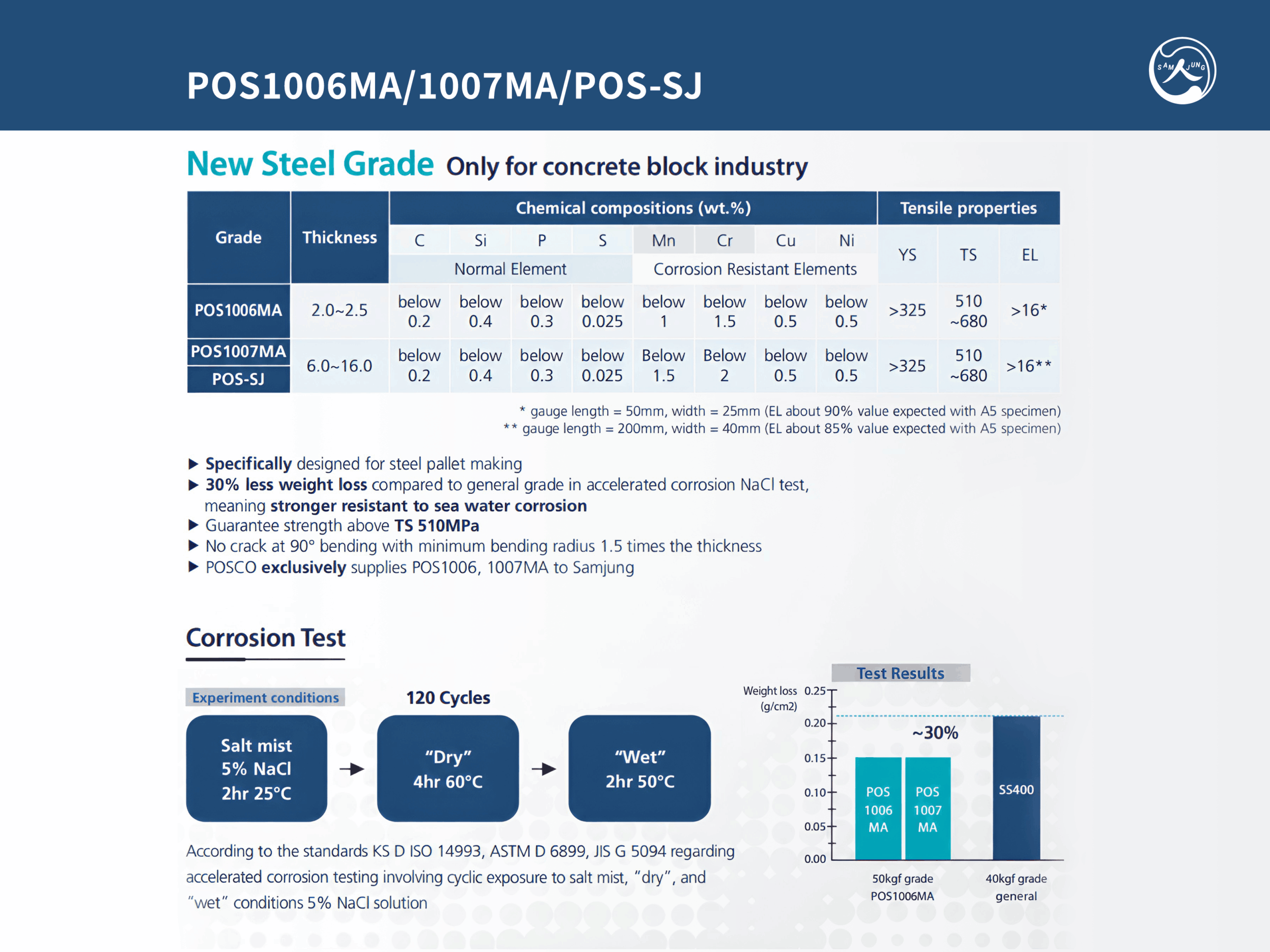
The following values are based on internal material records and comparative data on supplied materials compiled by Samjung. They are reference values for technical comparison.
| Element | POSSJ | HS540 |
|---|---|---|
| Carbon (C) | 0.069–0.072% | 0.0618–0.2788% |
| Silicon (Si) | 0.012–0.018% | 0.064–0.207% |
| Manganese (Mn) | 0.956–0.982% | 1.222–1.494% |
| Copper (Cu) | 0.266–0.270% | Reported as not detected |
Chemical composition may vary depending on the applicable production specifications and manufacturing lot. Because the carbon content range presented for HS540 is wider than those for the other elements, the lots and analytical conditions included in the data, as well as the possibility of transcription errors, need to be checked. Likewise, because the analytical method and detection limit for copper reported as “not detected” have not been provided, this entry must not be interpreted as a content of 0%.
These data must be used within the scope of the relevant records and must not be extended to serve as a composition guarantee for all supplied products or as direct evidence of corrosion resistance or wear resistance. The suitability of materials actually delivered must be verified against the supply specifications and inspection data for the relevant lot.