
Next-Generation Steel Production Board Redesigned Through High-Performance Materials and Structural Engineering
 Resources White Papers Next-Generation Steel Production Board Redesigned Through High-Performance Materials and Structural Engineering
Premium Material Performance, Lightweight Structural Engineering and Verified Vibration Performance
Technical Paper | Samjung Industries Co., Ltd.
Executive Summary
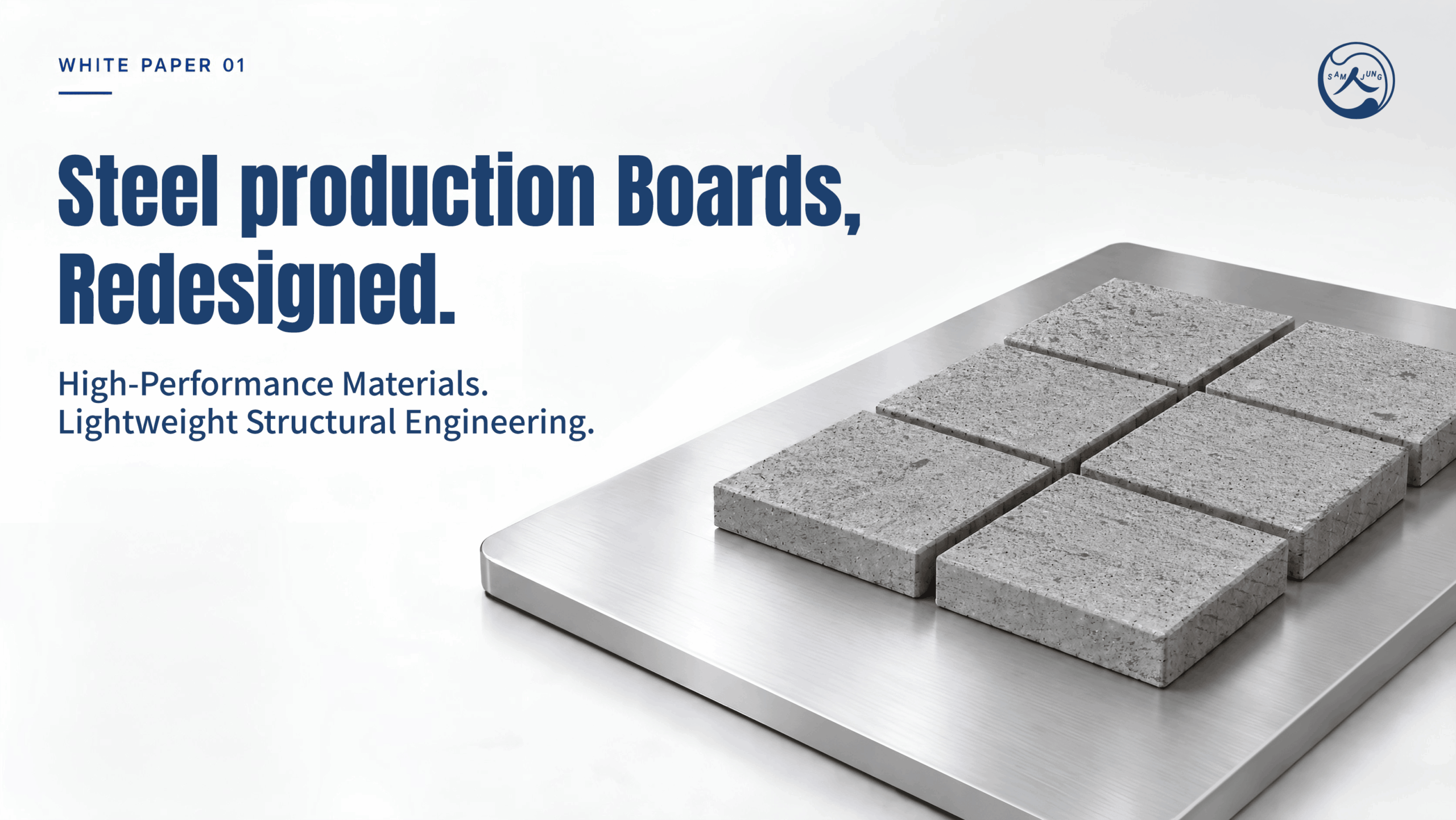
In concrete block and paver production, a Steel Production Board (Steel Pallet) is not simply a supporting board used to transport formed products. It is a key production component that transmits vibration generated by the vibration table to the mold and concrete mixture, supports the loads generated during the forming process, and repeatedly moves along the production line during every production cycle.
Traditional Steel Production Boards, based on the Effective vibration transmission capability and durability inherent in steel, offer the advantage of maintaining stable production performance even under demanding production conditions involving high vibration intensity, long periods of continuous production, repeated loads and mechanical impacts, and wide temperature variations. In Samjung’s extensive field experience, it has been very rare to observe customers who, after adopting Steel Production Boards, switch back to wooden, plastic, or composite production boards. This is because steel provides not only durability but also consistent performance and high production stability over long periods of repeated production.
However, through its long experience in manufacturing Steel Production Boards (Steel Pallet), Samjung focused on how material performance could be utilized more effectively. Steel Production Boards are continuously exposed to moisture, concrete residue, abrasion, cleaning, and repeated mechanical contact. Applying materials with high corrosion resistance and surface durability, such as galvanized steel (GI) or stainless steel, can therefore provide clear advantages. However, the properties of these high-performance materials are not required to the same degree in every part of a Steel Production Board. Samjung therefore focused on an approach that concentrates high-performance materials on the surfaces where their properties are actually required, while using a separately engineered internal structure to achieve the necessary performance, thereby utilizing the properties and functions of the materials more efficiently.
The second area Samjung focused on was the impact of Steel Production Board (Steel pallet) weight on long-term production efficiency. Continuously rising energy costs are an important challenge facing the manufacturing industry, and Steel Production Boards repeatedly move and stop, rise and descend during every production cycle on the production line. Samjung recognized that reducing the weight of a steel Production Board could not only reduce transportation costs but also contribute to reducing the load on production equipment and wear on components, as well as lowering electricity consumption. In particular, because steel Production Boards are long-term production assets used for more than 10 years, Samjung placed significant importance not only on the initial purchase cost but also on the economic benefits that accumulate for customers over longer periods of use. Based on these considerations, MetaBoard® was developed by redesigning the structure of the conventional Production Board.
The Structural Dilemma MetaBoard® Seeks to Address
| Challenges of Traditional Steel Production Board | MetaBoard® Design Approach |
|---|---|
| Inefficiency of applying high-performance materials throughout the entire board | Concentrating high-performance materials on the surfaces where they are required |
| High self-weight | Reducing weight through structural engineering |
| Continuous load on production equipment due to high weight | Reducing the burden on equipment and related components through lightweight design |
| Accumulation of energy and operating costs over long-term use | Seeking to reduce electricity consumption and long-term operational burden |
| (Additional content) Material utilization in conventional structures | (Additional content) Efficiently arranging materials and structure according to required performance |
Based on these considerations, Samjung arrived at a fundamental design question. Could the advantages of high-performance, corrosion-resistant materials be effectively applied where they are needed, while redesigning the structure of the Steel Production Board to reduce weight and, at the same time, improve the long-term burden on production equipment, energy use, transportation, and handling?
This question became the starting point for the development of MetaBoard®.
MetaBoard® is not a product made lighter simply by reducing the thickness of the Steel Production Board. It is a product that redesigns the structure of the conventional Steel Production Board itself. High-performance materials such as galvanized steel (GI) or stainless steel are applied to the exterior, where high corrosion resistance and surface durability are required, while the interior incorporates a proprietary structure engineered to provide the necessary stiffness and load-bearing performance. In this way, effectively utilizing material performance where it is needed while simultaneously reducing weight is the core design approach of MetaBoard®.
In other words, the essence of MetaBoard® lies not simply in using more high-quality material, but in applying the performance of each material where it is needed most and designing the structure efficiently. Through this approach, MetaBoard® aims to retain the advantages of Steel Production Boards in terms of vibration transmission and production stability while reducing weight and lowering the burden on production equipment, energy use, transportation, and handling over long-term use. Redesigning materials and structure according to their intended purpose to improve long-term production efficiency is the fundamental design philosophy that distinguishes MetaBoard® from conventional Steel Production Boards.
1. Advantages and Structural Limitations of Conventional Steel Production Boards
Improving Structural Limitations While Retaining the Advantages of Steel
There are clear reasons why steel Production Boards (Steel Pallet) have long been used in concrete block and paver production. Steel offers high stiffness and stable load-bearing performance, as well as the ability to effectively transmit the vibration required for compacting concrete products. Therefore, the starting point for the development of MetaBoard® was not to give up these advantages of steel.
What Samjung focused on was how to improve the limitations of the conventional structure while retaining the advantages of steel Production Boards.
Conventional steel Production Boards are manufactured with the same steel grade throughout the entire cross-section. This approach has the advantages of structural simplicity and ease of achieving the required stiffness. However, as the size and thickness of the Production Board increase, the amount of steel used also increases, resulting in a corresponding increase in the weight of the Production Board itself.
This weight becomes even more significant during the production process. A Production Board is not a static structure that remains fixed in one place and merely supports loads. Rather, it is a production component that repeatedly undergoes acceleration and movement, stopping, rising and descending, positioning, and vibration during every production cycle.
Therefore, the weight of a Production Board is not simply a factor to consider during transportation or installation. It is a mass that production equipment must repeatedly move during every production cycle, while also acting as a continuous self-load on the Production Board itself. In particular, as the size of the Production Board increases, the mass that production equipment must repeatedly move also increases. Weight therefore becomes a factor that must be considered when evaluating long-term equipment operation and production efficiency.
Ultimately, simply applying higher-performance materials cannot fully address the issues of weight and material usage inherent in conventional steel Production Boards. Alongside an approach that improves the performance of the material itself, a new approach is required to determine how materials should be positioned and how the structure should be designed while maintaining the required performance.
The structural design of MetaBoard® began with this consideration.
2. Structural Design Principles of MetaBoard®
Changing How High-Performance Materials Are Used Rather Than Giving Them Up
One of the most direct ways to improve the corrosion resistance and surface durability of a steel Production Board is to apply high-performance materials such as galvanized steel (GI) or stainless steel. These materials are advantageous for protecting the surface of the Steel Production Board in production environments where it is exposed to moisture, concrete residue, cleaning, abrasion, and repeated mechanical contact.
However, using high-performance materials throughout the entire cross-section of a steel Production Board requires a significant amount of costly material. In particular, manufacturing the entire board from stainless steel can provide high corrosion resistance, but it also significantly increases material costs. Therefore, what matters is not simply using better materials, but identifying and applying each material where its performance is actually required.
From this perspective, Samjung distinguished the functions that each part of the Steel Production Board must perform. Because the exterior surfaces are directly exposed to moisture, concrete residue, cleaning, abrasion, and mechanical contact, corrosion resistance and surface durability are important. For the interior, on the other hand, rather than requiring the same level of surface corrosion resistance as the exterior, it is important to secure the stiffness, load support, load distribution, deflection control, and dimensional stability required of the Production Board.
Based on these functional differences, MetaBoard® applies an approach that combines high-performance surface materials with a separately engineered internal structure.
| Area | Primary Role | MetaBoard® Design Approach |
|---|---|---|
| Exterior Surface | Corrosion resistance and surface durability | Application of galvanized steel (GI) or stainless steel |
| Internal Structure | Stiffness, load support and distribution, deflection control, and dimensional stability | Separately engineered to achieve the required structural performance |
Depending on the customer’s production environment and requirements, galvanized steel (GI) or stainless steel can be applied to the exterior surfaces of MetaBoard®. Galvanized steel can be used when improved corrosion protection compared with conventional steel is required while also considering cost competitiveness, while stainless steel can be selected for production environments requiring a higher level of corrosion resistance.
Instead of filling the entire interior with the same high-performance material, the internal structure is engineered to provide the required stiffness and load-bearing performance. In this way, materials are utilized by applying the required performance where it is needed, taking into account the properties of the materials and the functions of each part.
In other words, the essence of MetaBoard® does not lie simply in using more high-quality materials. Distinguishing between areas that require high-performance materials and areas that require structural performance, and arranging the materials and structure according to their intended purposes, is the fundamental design principle of MetaBoard®.
3. Lightweight Design Through Structural Engineering
Simply Making It Thinner Is Different from Making It Structurally Lighter
The simplest way to reduce the weight of a Steel Production Board is to reduce its thickness. However, simply reducing the thickness can also affect the flexural stiffness and deflection characteristics of the Production Board. Therefore, lightweighting without considering the structural performance required for production differs from the approach pursued by MetaBoard®.
Rather than simply reducing thickness, MetaBoard® achieves weight reduction by replacing the conventional uniform steel construction with an engineered structure designed to provide the required performance. In other words, instead of filling the entire cross-section with the same steel, the design distinguishes between where material is required and where structural functions are required.
Depending on product size and specifications, MetaBoard® can be designed at approximately 60% of the weight of a traditional steel Production Board. However, what matters here is not simply the percentage of weight reduced. It is important to maintain the functions that the Steel Production Board must perform during the production process even while reducing weight.
Accordingly, the lightweight structural design of MetaBoard® can be understood as an integrated design process consisting of material selection → material placement → structural design → weight optimization → securing the performance required for production.
The question MetaBoard® seeks to address also lies here: How much unnecessary weight can be reduced while maintaining the required production performance? Rather than simply reducing weight, the design direction of MetaBoard® is to achieve a balance between structural performance and lightweighting.
4. Load-Bearing and Structural Performance
Securing the Required Structural Performance While Reducing Weight
One of the most fundamental functions of a Production Board is to stably support the loads transferred from the mold and concrete products. Therefore, for a lightweight Steel Production Board, what matters is not simply reducing weight, but how to secure the structural performance required for production at the reduced weight.
The internal structure of MetaBoard® is designed to provide stiffness, load distribution, deflection control, and dimensional stability. Instead of filling the entire cross-section with the same steel, as in a traditional steel Production Board, the internal structure is engineered to perform the structural functions required in the actual production process while reducing unnecessary weight.
| Structural Requirement | Design Objective |
|---|---|
| Stiffness | Secure the structural stability required during the production process |
| Load Support and Distribution | Support loads transferred from the mold and concrete products |
| Deflection Control | Limit excessive deformation under load |
| Dimensional Stability | Maintain the shape and dimensions required under repeated production conditions |
Under Samjung’s internal product criteria, production loads of up to approximately 2 tons are considered, based on product specifications and fully supported conditions. However, this does not represent a fixed value guaranteed equally across all application environments. The actual applicable load must be individually evaluated according to factors such as Production Board size and thickness, support conditions, and production equipment configuration.
Weight itself is also a factor to be considered in structural design. The weight of a conventional steel Production Board contributes to the total moving mass that production equipment must repeatedly handle during each production cycle. MetaBoard® is designed to reduce this mass while maintaining the required stiffness and load distribution performance through its engineered internal structure.
Therefore, lightweighting does not necessarily mean a reduction in structural performance. What MetaBoard® seeks to achieve is a reduction in the weight of the Steel Production Board itself while taking into account the structural performance actually required during the production process.
5. Why Is Vibration Performance Important?
The Production Board Is Part of the Vibration System
In concrete block and paver production, the role of a Production Board extends beyond supporting loads. Vibration generated by the vibration table is transmitted through the Production Board and mold to the concrete mixture. Therefore, the Production Board can also be regarded as part of the system that transmits vibration during the concrete forming process.
The vibration transmission path can basically be described as follows:
Vibration Table → Production Board → Mold → Concrete Mixture
Accordingly, factors such as the weight, density, material properties, structure, stiffness, flatness, and clamping conditions of the Production Board may be related to its vibration behavior. For this reason, the performance of a lightweight Production Board cannot be evaluated solely on the basis of how light the product is.
What matters is the extent to which the vibration performance required for concrete production can be maintained while reducing weight. If weight reduction itself were the only objective, it could be achieved simply by selecting a lighter material. In actual production, however, vibration must be transmitted through the Production Board. Lightweighting and vibration performance must therefore be evaluated together.
Rather than explaining the concept of this lightweight structure solely through design logic, Samjung evaluated it through an independent concrete research institute under actual concrete block production equipment conditions.
The test provides a basis for examining, in the following section, the vibration characteristics demonstrated by the lightweight structure of MetaBoard® under actual production conditions.
6. Performance Verification Through Independent CERIB Testing
Vibration Performance of a Lightweight Structure Evaluated Under Actual Production Conditions
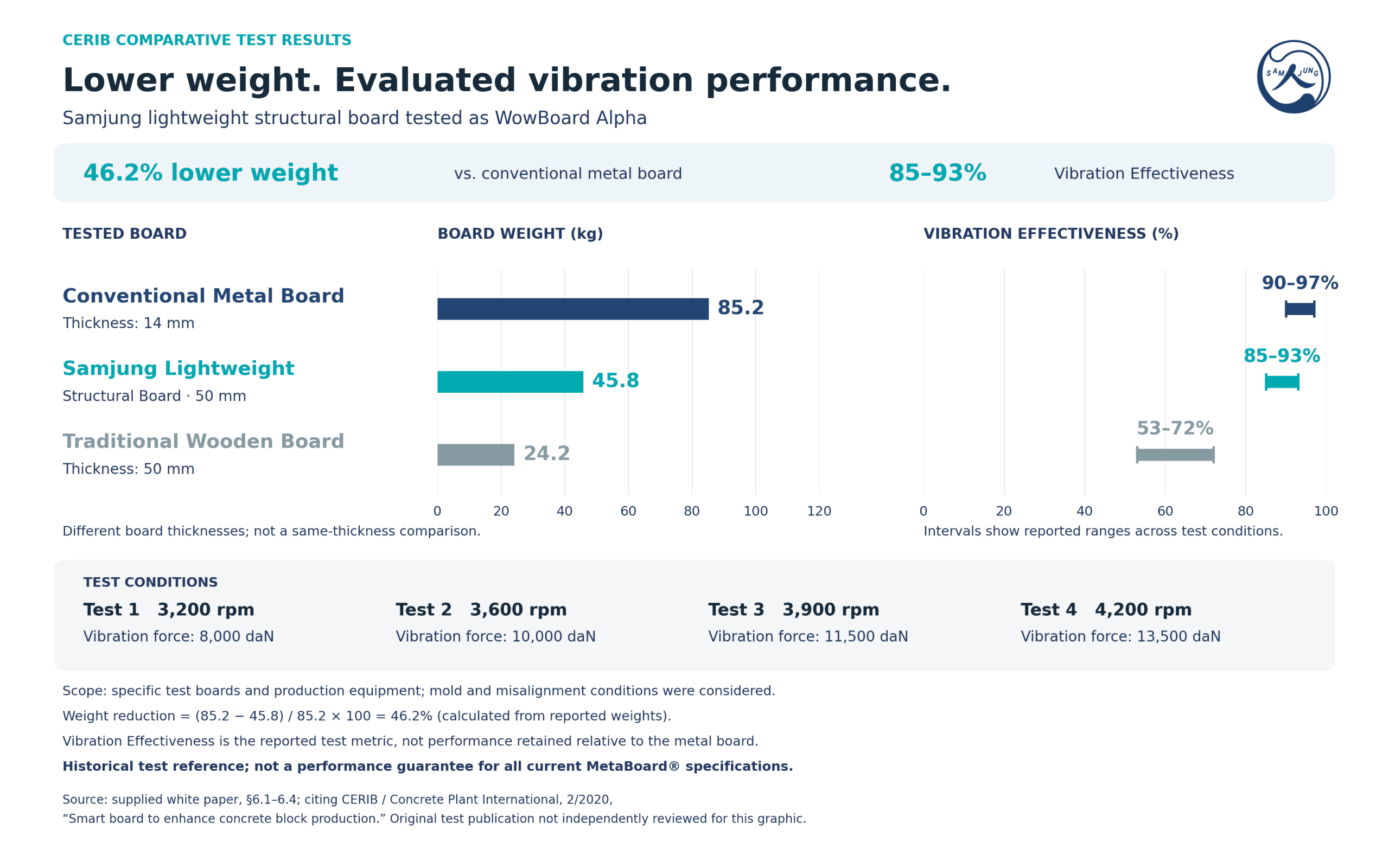
Samjung’s lightweight structural Production Board was evaluated using actual concrete block production equipment at CERIB (Centre d’Études et de Recherches de l’Industrie du Béton), a French concrete industry research institute. At the time of testing, the product was named WowBoard Alpha.
CERIB explained that performance evaluations of conventional Production Boards have often focused on characteristics such as dimensions, squareness, hardness, sanding resistance, and bending, while information on vibration transmission under actual production conditions has been relatively limited. Samjung therefore used CERIB’s Abilys® Smart Board Technology to evaluate the vibration behavior of the Production Board using actual concrete block production equipment.
6.1 Test Conditions
The CERIB test did not use only one fixed vibration condition. Different rotational speeds and vibration forces were applied to account for the various conditions that may occur in actual production environments.
| Test | Rotational Speed | Vibration Force |
|---|---|---|
| 1 | 3,200 rpm | 8,000 daN |
| 2 | 3,600 rpm | 10,000 daN |
| 3 | 3,900 rpm | 11,500 daN |
| 4 | 4,200 rpm | 13,500 daN |
The test also considered mold conditions for blocks, paving products, and road products, and applied misalignment conditions to reproduce wear conditions in actual production equipment. The significance of this test therefore lies in the fact that it did not simply compare different materials under static conditions, but evaluated the vibration behavior of Production Boards under various conditions that may occur in actual concrete production.
6.2 CERIB Comparative Test Results
The key comparative results presented in CERIB’s publicly available materials are as follows.
|
Production Board |
Thickness |
Weight |
Vibration Effectiveness |
|---|---|---|---|
|
Conventional Metal Board |
14 mm |
85.2 kg |
90–97% |
|
Samjung Lightweight Structural Board |
50 mm |
45.8 kg |
85–93% |
|
Traditional Wooden Board |
50 mm |
24.2 kg |
53–72% |
The Samjung lightweight structural board tested weighed 45.8 kg, compared with 85.2 kg for the conventional metal board, representing approximately 46% lower weight. Despite this, it demonstrated 85–93% Vibration Effectiveness under different test conditions. In comparison, the traditional wooden board recorded a range of 53–72%.
When interpreting these results, it is important to consider the balance between weight and vibration performance. While the conventional steel board demonstrated the highest Vibration Effectiveness in the CERIB test, the Samjung lightweight structural board achieved 85–93% Vibration Effectiveness while weighing approximately 46% less.
What should be noted in the test results is that the Samjung lightweight structural board demonstrated 85–93% Vibration Effectiveness despite weighing approximately 46% less than the conventional steel board. In other words, under these test conditions, the reduction in weight did not result in a proportional reduction in vibration performance.
This provides an important technical basis for examining the central question behind MetaBoard®’s lightweight structural design: “To what extent can the vibration performance required for production be maintained while reducing weight?”
6.3 Difference in Vibration Transmission Compared with a Board of Similar Weight
The CERIB test also evaluated Board X, a separate comparison board with a size and weight similar to those of the Samjung lightweight structural board.
In Samjung’s information related to the test, Board X is categorized as a plastic/composite-type Production Board. However, CERIB’s publicly available materials do not disclose its specific material specifications and describe it only as “another material (not steel).” Accordingly, this white paper does not extend the interpretation to suggest that CERIB directly identified or confirmed the specific material of the board.
The Samjung lightweight structural board weighed approximately 45 kg, while Board X weighed approximately 42 kg, making the two boards similar in weight. However, CERIB’s analysis indicated that Board X was expected to have approximately 7% greater vibration transmission loss than the Samjung board. CERIB explained that vibration transmission loss across the entire board is related to density, while the mechanical and dynamic properties of the material also affect vibration transmission.
This comparison demonstrates that lightweight Production Boards cannot be evaluated solely by weight. Similar weight does not necessarily result in the same vibration characteristics, and material, structure, and dynamic properties must be considered together.
Therefore, when evaluating a lightweight Production Board, it is necessary to consider not only “how light it is,” but also the level of vibration performance required for actual production that can be achieved at that weight.
6.4 What the CERIB Test Shows — and What It Does Not
The CERIB test is an important independent test reference for explaining Samjung’s lightweight structural Production Board technology. However, it is important to clarify that the product used in the test was WowBoard Alpha and that the results were obtained by evaluating a product of a specific size and specification using specific production equipment and test conditions.
Accordingly, these results should not be extended to mean that identical performance is guaranteed for all sizes and specifications of MetaBoard® currently available or across all concrete block production equipment.
What the CERIB test directly demonstrates is that a specific Samjung lightweight structural Production Board simultaneously achieved significantly lower weight than the conventional steel board and 85–93% Vibration Effectiveness under various test conditions using actual concrete block production equipment.
This white paper clearly distinguishes this scope and uses the CERIB results not as a direct performance guarantee for all current MetaBoard® specifications, but as an independent technical reference for explaining Samjung’s lightweight structural Production Board technology.
7. What Lower Weight Means for Production Equipment and Energy Efficiency
Looking Beyond the Weight of a Single Board to Repeated Production Cycles
What was directly confirmed through the CERIB test was the weight and vibration performance of the tested Production Board. In contrast, the long-term effects of MetaBoard®’s lower weight on the energy consumption of production equipment or the service life of components were not directly measured in that test.
Accordingly, this section distinguishes these considerations from CERIB’s direct test results and examines the effects that can be expected from an engineering perspective as a result of reducing Production Board weight.
During every production cycle, a Production Board repeatedly undergoes acceleration and deceleration, movement, rising and descending, and positioning along the production line. Therefore, reducing the weight of the Production Board also reduces the mass that production equipment must repeatedly move each time these operations are performed.
This can act to reduce the mechanical load transmitted to conveyors, chains, rollers, bearings, elevators, lowerators, motors, gearboxes, and Production Board transfer systems. In environments where these mechanical loads are repeated over long periods, it may also contribute to reducing wear and fatigue loads on related components.
However, the extent to which the actual service life of components may increase depends on factors such as the structure of the production equipment, production speed, operating cycles, and maintenance conditions. Therefore, without separate field verification, this white paper does not conclude that MetaBoard® extends the service life of equipment or components by any specific percentage.
7.1 Potential for Energy Efficiency
Reducing the weight of a Production Board can also have implications for energy use. During every production cycle, production equipment moves, accelerates, and decelerates the Production Board and raises or lowers it to the required position. Under the same production conditions, if the mass of the Production Board that must be moved is reduced, the mass that the equipment must repeatedly move is also reduced.
Lightweighting can therefore act to reduce the mechanical energy required to move the Production Board. In particular, this difference should be considered not only in terms of a single movement, but in the context of the numerous production cycles repeated throughout the day.
MetaBoard®’s approach to energy efficiency goes beyond simply stating that “a lighter Production Board is easier to move.” The central point is to reduce the mass that production equipment must accelerate, move, raise, and lower during every production cycle.
However, the actual level of electricity savings may vary depending on the structure of the production equipment, motor efficiency, acceleration and deceleration conditions, production speed, elevator system, conveyor configuration, and control method. Therefore, no specific electricity-saving rate is presented without separate on-site energy measurements.
7.2 Implications for Handling and Work
Lightweighting is relevant not only to production equipment but also to work involving the direct handling of Production Boards. Depending on their size and thickness, Conventional steel Production Boards can be considerably heavy, potentially requiring multiple workers or separate lifting equipment during maintenance or replacement.
The lower weight of MetaBoard® can act to reduce the physical burden involved in these handling processes. Depending on product size, weight, and the working environment, moving and replacing Production Boards may become easier, and in some operations it may contribute to reducing the number of personnel required or the burden associated with handling heavy loads.
However, the weight that workers can directly handle and the appropriate working method cannot be determined solely by the characteristics of the product itself. Actual handling feasibility must be determined according to the safety standards and handling procedures of each workplace, as well as the equipment used and the working environment.
8. Material Efficiency and Sustainability
Not Simply Using Less Material, but Using the Required Materials Efficiently
MetaBoard®’s approach to sustainability does not end with simply reducing product weight. The more fundamental concept is using materials efficiently according to the required performance and where they are needed.
A conventional steel Production Board consists of the same steel throughout its entire cross-section. In contrast, MetaBoard® applies high-performance materials such as galvanized steel (GI) or stainless steel to the exterior, where high corrosion resistance and surface durability are required due to direct exposure to moisture, concrete residue, cleaning, and abrasion, while the interior is separately engineered to provide the required structural performance.
Therefore, the material efficiency of MetaBoard® means more than simply “using less steel.” The key is identifying where high-performance materials are required and reducing unnecessary material use through structural design, thereby utilizing the properties of each material more efficiently.
This approach can ultimately lead to a reduction in the amount of high-performance material used, the total material input, and the overall weight of the product. In other words, MetaBoard® considers not only the performance of the material itself, but also which material should be used, where it should be used, and for what purpose as part of its structural design.
Sustainability Across the Product Lifecycle
This material efficiency and lightweight design can have implications across multiple stages, from the manufacture and transportation of the Production Board to production and handling.
|
Stage |
Implications of MetaBoard® Design Characteristics |
|---|---|
|
Manufacturing |
Seeks to reduce total material input by placing materials where they are required |
|
Transportation |
Reduces the total transported mass for the same quantity of products through lower product weight |
|
Production |
Reduces the mass that production equipment must repeatedly move |
|
Handling & Maintenance |
May reduce the physical handling burden during replacement and maintenance |
At the manufacturing stage, reducing the total material input may contribute to lowering the environmental burden associated with material production. At the transportation stage, reducing the weight of each product also reduces the total transported mass when the same quantity is shipped.
At the production stage, as discussed earlier, the mass that production equipment must move during every production cycle can be reduced. During handling and maintenance, lower product weight may also contribute to reducing the physical workload.
Therefore, the direction pursued by MetaBoard® can be summarized as using the materials required for manufacturing efficiently, reducing the weight that must be transported, and reducing the mass that production equipment must repeatedly move.
However, separate verification is required to determine the extent to which these characteristics actually reduce environmental impact or carbon emissions. Accurately calculating carbon emission reductions would require a life cycle assessment (LCA) or product carbon footprint analysis that includes material composition, manufacturing processes, transportation distance, product service life, and energy use during production.
Accordingly, this white paper does not claim, without separate verification, that MetaBoard® reduces carbon emissions by any specific percentage. Within the scope that can currently be confirmed, this white paper distinguishes between the design characteristics of using materials efficiently according to their intended purpose and reducing product weight, and the effects that may be expected from those characteristics.
9. Manufacturing Precision and Production Equipment Compatibility
Maintaining Manufacturing Precision While Reducing Weight
The lightweight structure of MetaBoard® is not achieved by sacrificing the manufacturing precision required of a Production Board. Because a Production Board repeatedly moves through production equipment, supports the loads of the mold and concrete products, and transmits vibration, not only its size and shape but also its flatness and thickness tolerance must be carefully controlled.
MetaBoard® is manufactured using a precision press-forming process according to the dimensions required by the customer. When required, the four corners can also be manufactured to the radius specified by the customer.
During manufacturing and quality control, flatness, thickness tolerance, squareness, structural integrity, surface condition, and permanent deformation are considered key control items. Through this process, MetaBoard® aims to secure the dimensional and structural stability required during production while applying a lightweight structure.
MetaBoard® undergoes a heat-treatment process at approximately 350°C during manufacturing. However, the specific technical purpose of this process and its effect on performance should be explained based on Samjung’s final manufacturing specifications and technical information that can be publicly disclosed. Therefore, this white paper does not extend the explanation to claim, without separate supporting evidence, that this heat treatment improves any specific material property.
Compatibility with Existing Steel Production Board Lines
When introducing a new Production Board, compatibility with existing production equipment is important in addition to the performance of the product itself. If the thickness of the Production Board differs significantly from that of the existing product, adjustments or modifications may be required to magazines, elevators, lowerators, conveyors, clamping systems, and Production Board feeding systems.
MetaBoard® is designed so that it can be manufactured within the same nominal thickness range used by customers operating conventional steel Production Boards. Therefore, the application of MetaBoard® can be considered for production lines currently using conventional steel Production Boards. Depending on the conditions of the production equipment, the use of conventional steel Production Boards and MetaBoard® together on the same production line may also be considered.
In other words, introducing MetaBoard® does not necessarily mean that the entire production line must be changed in order to change the Production Board. The basic approach is to evaluate its applicability while considering compatibility with existing equipment.
However, actual applicability or the feasibility of using MetaBoard® together with conventional steel Production Boards may vary depending on factors such as the allowable tolerances of the production equipment, the clamping system, and the configuration of the Production Board transfer system. Individual evaluation is therefore required before implementation.
10. A New Standard for Evaluating Production Boards
Weight, Thickness, or Price Alone Is Not Enough
A Production Board is not simply a supporting board used to transport concrete products. It is a production component that supports loads, transmits vibration, and continuously moves along the production line during the production process. Therefore, a single indicator such as price, thickness, or weight is not sufficient to fully evaluate actual production performance and long-term value.
In particular, for lightweight Production Boards, simply comparing how light they are is not sufficient. It is necessary to consider together the extent to which the required structural and vibration performance is maintained while reducing weight, whether the board can be applied to existing production equipment, and what implications it may have for long-term production and maintenance.
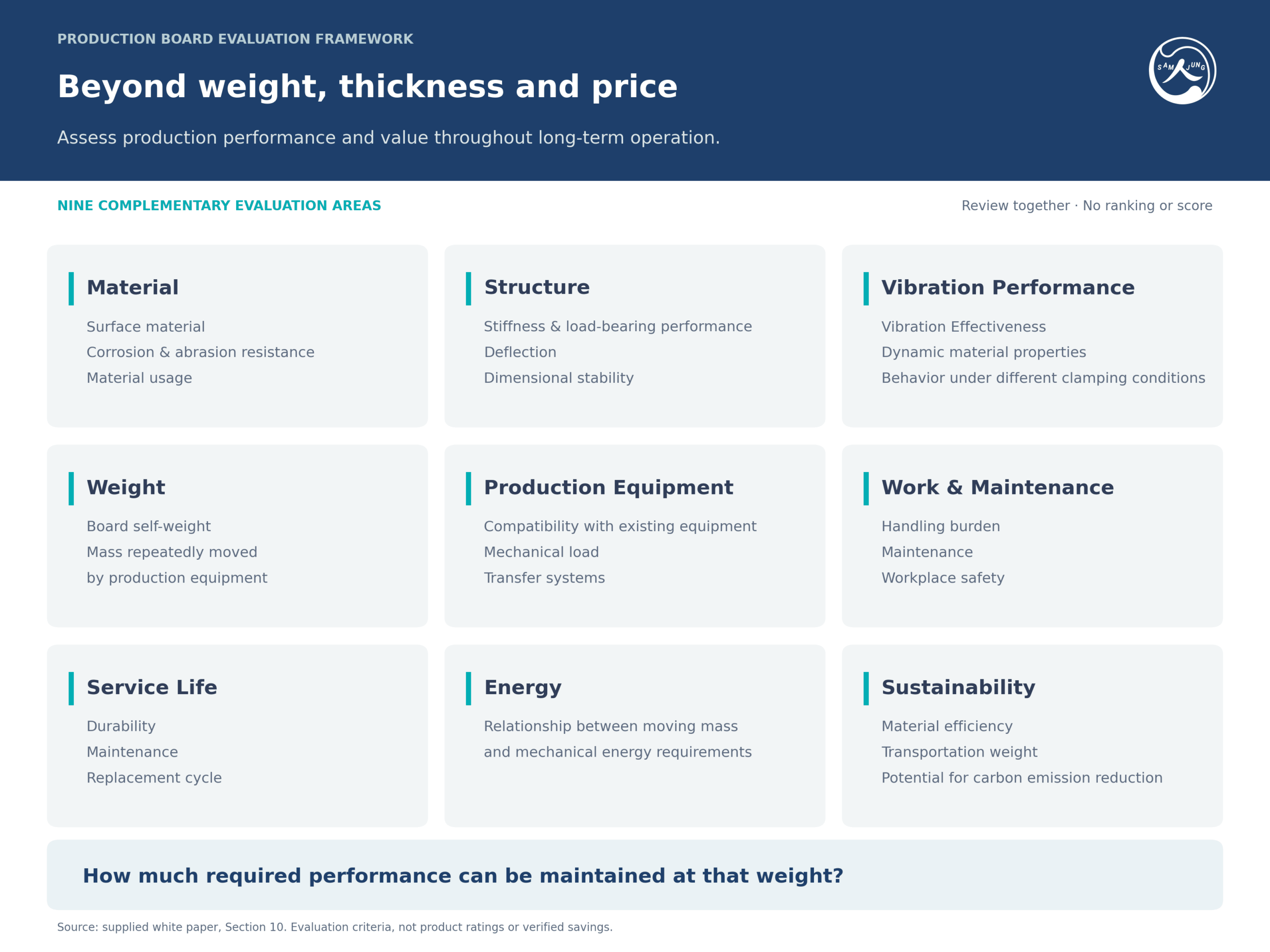
From this perspective, Samjung proposes comprehensively evaluating Production Boards according to the following criteria.
|
Evaluation Area |
Key Evaluation Factors |
|---|---|
|
Material |
Surface material, corrosion resistance, abrasion resistance, material usage |
|
Structure |
Stiffness, load-bearing performance, deflection, dimensional stability |
|
Vibration Performance |
Vibration Effectiveness, dynamic material properties, behavior under different clamping conditions |
|
Weight |
Weight of the Production Board itself, mass repeatedly moved by production equipment |
|
Production Equipment |
Compatibility with existing equipment, mechanical load, transfer systems |
|
Work & Maintenance |
Handling burden, maintenance, workplace safety |
|
Service Life |
Durability, maintenance, replacement cycle |
|
Energy |
Relationship between moving mass and mechanical energy requirements |
|
Sustainability |
Material efficiency, transportation weight, potential for carbon emission reduction |
Ultimately, when evaluating a lightweight Production Board, the question should not end with, “How light is it?”
What matters more is how much of the performance required for production can be maintained at that weight, and what value it can provide throughout long-term production and operation.
11. Technical Positioning of MetaBoard®
Balancing the Production Performance of Steel with Lightweight Structural Design
Each material and structure used for Production Boards has its own characteristics. Conventional steel Production Boards provide high stiffness and excellent vibration performance, while also increasing the weight of the product itself and the amount of material used. Traditional wooden boards are relatively lightweight, but in the CERIB test they demonstrated lower Vibration Effectiveness than the conventional metal board and the Samjung lightweight structural board.
Weight reduction can also be achieved with plastic or composite materials. However, as shown earlier in CERIB’s comparison with Board X, differences in vibration transmission may occur due to the mechanical and dynamic properties of materials even when board weights are similar. Because CERIB’s publicly available materials do not disclose the specific material of Board X, these results are not used as a basis for generalizing the performance of plastic or composite materials as a whole.
The direction pursued by MetaBoard® is not to maximize only one of these characteristics. Its fundamental approach is to build on the production performance of steel Production Boards, apply high-performance surface materials where required, and reduce weight through structural design.
|
Type |
Key Characteristics |
|---|---|
|
Conventional Steel Production Board |
High stiffness and vibration performance, high weight and material usage |
|
Traditional Wooden Board |
Low weight, relatively lower Vibration Effectiveness in the CERIB test |
|
Board X |
Different vibration transmission characteristics observed at a weight similar to the Samjung test board |
|
MetaBoard® |
Combines high-performance surface materials with lightweight structural design to pursue a balance among the required structural performance, vibration performance, and weight |
Therefore, the technical positioning of MetaBoard® is difficult to define simply as a “lightweight Steel Production Board.” It is more appropriate to view it as a Steel Production Board that seeks a balance between production performance and long-term operational efficiency by considering durability, structural stability, vibration performance, weight, material efficiency, cost competitiveness, the potential burden on production equipment, and the potential for energy efficiency together.
Samjung's Two Technical Approaches
Samjung’s Steel Production Board technologies can broadly be divided into an approach that advances material performance and an approach that advances the structure in which materials are used.
WowBoard® is based on a conventional steel structure and applies specialized steel grades to improve the performance and service life of the material itself. In other words, it begins with the question, “How can the performance of the material itself be improved?”
MetaBoard®, in contrast, applies corrosion-resistant materials where they are required and optimizes material usage through a separately engineered internal structure, reducing overall weight while securing the required structural performance. In other words, it begins with the question, “How can high-performance materials be used more efficiently?”
Therefore, WowBoard® and MetaBoard® are not concepts that negate each other’s advantages or compete to solve the same problem. While WowBoard® is an approach that advances the performance of the material itself, MetaBoard® can be distinguished as an approach that advances material placement and structure.
These two directions demonstrate that Samjung views a Steel Production Board not simply as a steel product, but as a production component whose materials and structure must be engineered according to the production environment and required performance.
Conclusion
Structural Design to Achieve the Required Performance with Less Weight
MetaBoard® was not developed simply to create a lightweight Steel Production Board. It began with the question of whether the advantages of conventional steel Production Boards could be retained while using materials more efficiently and reducing unnecessary weight through structural design.
High-performance materials such as galvanized steel (GI) and stainless steel offer clear advantages in environments where high corrosion resistance and surface durability are required. However, these properties are not required to the same degree in every part of a steel Production Board. MetaBoard® therefore applies high-performance materials to the exterior surfaces where their properties are required, while the interior is separately engineered to provide the necessary stiffness and load-bearing performance.
The key to this approach is not simply using more high-quality material, but placing the required performance where it is needed. In this way, MetaBoard® aims to utilize material properties efficiently while reducing the unnecessary weight associated with conventional structures.
The vibration performance of the lightweight structure was evaluated through independent CERIB testing under actual concrete block production equipment conditions. The Samjung lightweight structural board tested weighed 45.8 kg, compared with 85.2 kg for the conventional metal board, representing approximately 46% lower weight, while recording 85–93% Vibration Effectiveness under different test conditions. This demonstrates that, under these test conditions, the reduction in weight did not result in a proportional reduction in vibration performance.
However, this test does not directly demonstrate that MetaBoard® improves the electricity consumption of production equipment or the service life of components by any specific percentage. What was directly confirmed through the CERIB test was the weight and vibration performance of the tested board. The effects on production equipment and energy use must be distinguished from the effects that can be expected from lightweighting from an engineering perspective.
Nevertheless, the structural implications of reducing Steel Production Board weight are clear. During every production cycle, there is less mass for the production equipment to accelerate, less mass to move, and less mass to repeatedly raise and lower. This difference should be considered not in terms of a single movement, but from the perspective of production processes repeated over long periods.
Therefore, the value of MetaBoard® does not lie simply in how light a single Steel Production Board is. It should be evaluated by considering how efficiently materials are utilized, how the required structural and vibration performance is secured at the reduced weight, and what implications this design may have for long-term production and operation.
From this perspective, MetaBoard® redesigns materials and structure according to their intended purposes, seeking both more efficient material utilization and weight reduction while retaining the advantages of conventional steel Production Boards.
MetaBoard® — Engineering More with Less.
Technical Reference Note
CERIB — Centre d'Études et de Recherches de l'Industrie du Béton, France
Samjung’s lightweight Steel Production Board was evaluated for vibration performance under actual concrete block production equipment conditions using CERIB’s Abilys® Technology.
At the time of testing, the product was named WowBoard Alpha. Accordingly, this white paper does not use the test results as a direct performance guarantee for all sizes and specifications of the current MetaBoard®, but rather as an independent technical reference for explaining Samjung’s lightweight structural Production Board technology.
The test results were published in Concrete Plant International, Worldwide English Edition, 2/2020, “Smart board to enhance concrete block production.”
CERIB’s publicly available materials do not disclose the specific material specifications of Board X and describe it as “another material (not steel).” In Samjung’s information related to the test, the comparison board is categorized as a plastic/composite-type Production Board. Accordingly, this white paper does not extend the interpretation to suggest that CERIB directly identified or confirmed the specific material of Board X as plastic or composite material.