
Quality Starts Beneath the Block
 Resources Articles & News Quality Starts Beneath the Block
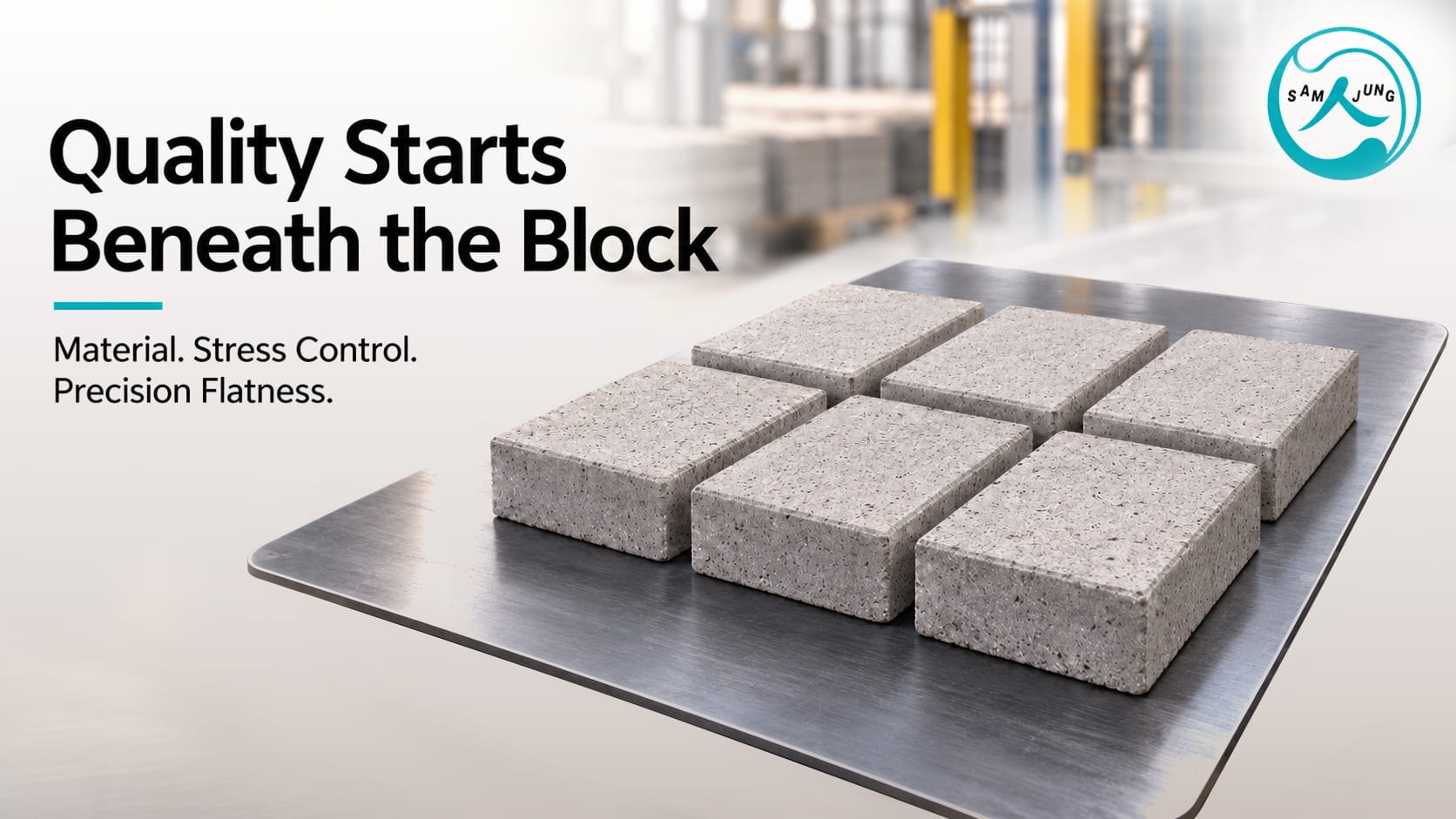
Same Machine, Same Mix. Can a Different Production Board Change Block Quality?
What does it take to make good concrete blocks?
A precise block machine, a well-designed mold, an appropriate concrete mix, and accurate vibration conditions may come to mind first.
Then, if production uses the same machine and mold, the same concrete mix, and the same vibration settings, shouldn’t the finished products have the same quality?
Not necessarily.
Generating vibration in the machine and transmitting that vibration energy uniformly and consistently to the concrete through the mold and production board are two different matters.
And the production board is one of the key components along that vibration transmission path.
Do the Same Vibration Settings Mean the Same Vibration Transmission?
In dry-cast vibrocompaction, vibration is a key factor in compacting concrete and producing dense products.
However, production boards use different materials, ranging from wood, plastic, and GMT to steel, and each material has different mass, stiffness, and damping characteristics. Therefore, they cannot be assumed to respond in the same way to the same vibration input.
When vibration is approximated as simple harmonic motion, the maximum vibration acceleration follows this relationship:
aₘₐₓ = (2πf)²A
Here, f is frequency, A is amplitude, and aₘₐₓ is maximum vibration acceleration.
In other words, even if the machine’s set frequency is the same, vibration acceleration can also change if the amplitude occurring in the actual system changes.
In the context of concrete block production, this can be connected as follows:
Machine Vibration Input
↓
Production Board Dynamic Response
↓
Vibration Transmission
↓
Amplitude (A) & Acceleration (a)
↓
Compaction Condition
↓
Density · Height · Product Consistency
Therefore, even with the same machine settings and concrete mix, the actual compaction conditions experienced by the products can differ if the production board’s dynamic characteristics differ.
Then, is a steel production board enough?
Here, we need to take the question one step further.
Are all steel production boards the same?
They are not.
The performance of a production board is not determined simply by the material name “steel.”
Both the type of steel used and how that steel is made into a production board matter.
Steel production boards undergo repeated vibration and loads during production, come into direct contact with concrete, and are exposed to moisture and contaminants.
Depending on the plant’s production environment, wear may be a major concern, while in wet environments, corrosion may affect the board’s long-term condition.
Therefore, if the material, thickness, and processing condition are unsuitable for the actual production environment, deformation, wear, and corrosion can occur during prolonged repeated use, potentially affecting the board’s flatness and service life.
This is why Samjung selects materials according to actual production conditions rather than applying a single steel grade to every environment.
Specialty Steel Suited to the Production Environment
HS540 can be used in production environments where high vibration, repeated loads, and wear are important considerations.
HS540 is a high-strength steel suitable for consideration under high-strength and repeated-load requirements, offering a material option that takes into account the structural stability and long-term usability required in production environments with high vibration and heavy loads.
Conversely, POS-SJ can be used in environments where corrosion is a significant concern due to continuous exposure to moisture and concrete residue.
POS-SJ is a specialty steel with a focus on corrosion resistance, developed with production board operating environments involving significant moisture and corrosion exposure in mind.
In other words, what matters is not choosing the highest steel grade.
It is identifying whether load, wear, or corrosion is the board’s main deterioration factor in the production environment and selecting a steel grade and board specification suited to those conditions.
However, selecting good steel alone does not produce a good production board.
How Good Steel Is Made into a Production Board
Steel may contain residual stress even in its original plate form, and additional stress may develop during cutting and processing into the required shape.
If this residual stress is not adequately managed, deformation or warping may occur after cutting and processing, making it more difficult to maintain a stable reference plane in a repetitive production environment.
This is why Samjung’s production board manufacturing does not end with cutting a steel plate to the required size.
Precision cutting is followed by deburring and pre-leveling. Then, through a four-stage leveling process that Samjung has developed over many years, residual stress within the steel is managed and precise flatness is achieved.
Inspection and surface protection follow before a production board is completed.
In other words, Samjung’s manufacturing philosophy follows a connected sequence:
Material Selection
↓
Precision Cutting
↓
Deburring & Pre-Leveling
↓
4-Stage Stress-Relief Leveling
↓
Precision Inspection
↓
Surface Protection
What matters here is not simply making the board look flat.
It is creating a reference plane that can maintain consistent, precise flatness during repeated production while managing residual stress within the steel.
Why Is Flatness So Important?
Multiple blocks are molded simultaneously on a single production board.
Therefore, good average flatness alone is not enough.
The entire board surface must provide a reference plane that is as uniform and stable as possible.
If deformation and elastic behavior vary across the board, the support conditions experienced by the products during molding, demolding, transfer, and curing can also differ.
Therefore, precision flatness is not merely a number in a dimensional inspection.
It is the precision of the production reference plane needed to maintain stable production conditions for concrete products throughout molding, demolding, transfer, and curing.
WowBoard Combines Materials and Manufacturing Technology
This is why Samjung’s WowBoard differs from a simple steel plate.
WowBoard’s performance cannot be explained by a single factor.
A steel grade suited to the production environment, a stress-relief process that manages residual stress, and precision leveling that achieves precision across the entire board surface work together.
Material × Stress Control × Precision Flatness × Stability
Samjung aims to create more than a stronger or flatter steel board.
By selecting materials suited to the production environment, managing residual stress, and creating a precise reference plane, Samjung aims to manufacture production boards that provide production conditions that are as uniform and stable as possible across the entire board surface.
The ultimate goal is not to make a good board, but to create a foundation that enables customers to produce good concrete products more consistently.
That is the direction WowBoard pursues.
Quality Starts Beneath Every Block and Paver
Concrete block and paver production technology continues to advance. Machines are becoming more precise, while molds, concrete mixes, and automation technologies are also advancing.
However, achieving consistent product quality depends just as much on how effectively vibration reaches the block or paver and how stable the reference plane beneath it remains as on the vibration generated by the machine.
This is why three questions are essential when selecting a production board.
What material is it made of?
How is it manufactured?
And how consistently can it maintain that precision?
Same Machine. Same Mold. Same Concrete Mix. Same Vibration Setting.
Even under the same production conditions, if the production board beneath them is different, the conditions experienced by each block or paver can differ.
Good quality starts beneath the product.
Quality Starts Beneath Every Block and Paver.