Technology

Production Board Technology from Materials to Validation

Innovation That Starts with Materials, Quality Completed Through Technology

Based on excellent materials, innovative structural design, and precision manufacturing and quality control technology, Samjung Industries provides high-quality steel production boards (steel pallets) and solutions that raise the efficiency of concrete production processes.
Through continuous research and development and technological innovation, we improve product performance and reliability and support our customers' productivity and competitiveness. In this way we realize a Win-Win management philosophy in which customers and Samjung Industries grow together.

Materials Structure Background

Materials · Structure »

Materials and Structural Design Tailored to the Production Environment
Quality Performance Background

Quality · Performance »

Manufacturing Standards That Verify Dimensions and Flatness

R and d Patents Background

R&D ·
Patents »

Development Achievements and Certification and Patent Records

Good Materials Become
Precise Boards, Leading
to Stable Production

Samjung's technology does not end with material selection. Based on differentiated materials and structural design and on precision manufacturing and quality control technology, we optimize our customers' production processes and, through continuous research and development and technological innovation, create new standards for steel production boards.

Steel Production Board Material Structure Icon

Materials · Structure

Foundation of Technology

Steel Production Board Precision Manufacturing Icon

Precision · Manufacturing

Securing Reliability

Steel Production Board Production Equipment Icon

Process Equipment Application

Customer Value

Steel Production Board Technology Innovation Icon

Technology Advancement

Future Technology

Steel Production Board 3d Scanning Quality Inspection

Completed with Precision Manufacturing Technology, Proven by Rigorous Quality Verification.

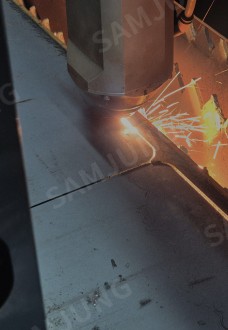
Samjung precisely manages the dimensional accuracy and flatness of steel production boards through precision cutting and four-stage leveling technology. We also apply systematic quality control standards from incoming materials to the final product and fully inspect the flatness of products with 3D scanning and AI vision inspection systems. Through precise quality control across the entire manufacturing process, we secure consistent product quality and stable production performance.

Flatness Made Precise,
Surface Made Harder

Leveling corrects the curvature of the steel production board, and the improvement in surface hardness from post-processing
was confirmed by testing.

To allow stable, long-lasting use in repeated production environments,
we consider flatness and surface hardness together.

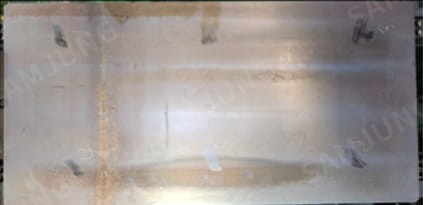
Steel Production Board Flatness Measurement
Steel Production Board Flatness Test Results
Marking of On-Site Measurement Specimens

Post-Processing Effect Confirmed by Testing

The same positions on an HS540 steel production board were measured before and after leveling. The surface was ground to reduce the effect of scale, and the change in hardness at each point was compared.

Test Subject
2 HS540 steel production boards, 6 points each (P1–P6)
Measuring Equipment
Mitutoyo portable hardness tester HH-411
Measured Value
Shore hardness HS (per raw material notation)
Measurement Method
After grinding the measurement area, two measurements within 3 mm of each point were averaged and compared

Hardness Measurements by Point

Changes by point ranged from −0.70 to +1.75 HS,
with hardness increasing at 9 points and decreasing at 3 points. In this HS540 specimen, hardness tended to increase after leveling.

12 points were measured, and
hardness increased at 9 points.

Measurement Point Before Leveling After Leveling Change (After − Before)
Board 1 · P1 23.50 24.85 +1.35
Board 1 · P2 22.55 23.50 +0.95
Board 1 · P3 23.10 24.55 +1.45
Board 1 · P4 24.75 24.25 −0.50
Board 1 · P5 23.55 24.40 +0.85
Board 1 · P6 24.50 24.85 +0.35
Board 2 · P1 23.70 23.45 −0.25
Board 2 · P2 23.15 24.25 +1.10
Board 2 · P3 24.45 23.75 −0.70
Board 2 · P4 22.80 23.60 +0.80
Board 2 · P5 21.80 22.50 +0.70
Board 2 · P6 21.20 22.95 +1.75

We carry on challenges from the field
into R&D achievements

We introduce our research and development history on production boards, the BoardCleaner and steel pallets, including new steel grades jointly developed by Samjung Industries with Hyundai Steel and POSCO. Company certificates and patent and design registration records are also available.

Samjung Research Development Achievements

Frequently Asked Questions

We have compiled the production conditions and board selection criteria that are often checked before adoption.

Samjung manufactures Steel Production Boards (Steel Pallet) using not only distinctive special steel grades but also proprietary manufacturing technologies and processes protected by patents. Drawing on expertise accumulated through years of research and development and precision manufacturing know-how, we deliver quality and performance that distinguish our products from those of other manufacturers, offering Steel Production Boards backed by Samjung’s proprietary technology.

Yes. Deformation can occur depending on operating conditions and maintenance.

Repeated production with loads exceeding the Steel Production Board’s allowable load, or continuous use of only one side, can cause deflection or deformation. In addition, as corrosion reduces the steel’s thickness, its load-bearing capacity can decrease, potentially increasing deformation.

For long-term, stable use, it is important to select an appropriate thickness and specifications based not only on the products you currently manufacture but also on your production plans for the next 10 years. During use, we recommend controlling corrosion and using a flipper to alternate between both sides.

One of the most important is precision manufacturing technology that maintains flatness over long periods of use. Cutting steel at high temperatures can cause subtle thermal distortion and residual stresses. Under repeated vibration and loading, these stresses can lead to gradual deformation, potentially affecting the bottom surface flatness, compaction uniformity, and density of concrete products over time.
Samjung Industries uses a proprietary four-stage leveling process to manage residual stresses. We design and manufacture our steel mold bases to achieve precise flatness at delivery while also accounting for potential deformation during long-term use.

Samjung conducts ongoing joint research with POSTECH and Handong Global University, both located in Pohang. Our in-house R&D center also reviews ways to improve each product’s performance and manufacturing processes every year while developing technologies needed for future production environments.

Research results are incorporated into product specifications and manufacturing processes after verification. Even when there are no major visible changes, we continuously improve details such as materials, structures, and processing methods, and Samjung’s products advance every year.

These improvements are incorporated into newly manufactured products. Therefore, even when purchasing the same product again, customers receive a more advanced version that reflects the research and development achievements made since their previous purchase.

Start a Technical Review for Your Production Conditions

Tell us your product and equipment conditions, and we will look at materials, quality and application direction together.